Walking Safari vs Game Drive: Which Experience Is for You?
Published 19 July 2026
Two Ways to Experience the Bush
The classic safari image - a game drive vehicle with its roof popped open, surrounded by wildlife on a dusty savanna track - has defined how most people picture an African wildlife experience. But there is a second, older, and in many ways more profound way to encounter Africa's wildlife: on foot, at eye level, guided by someone who knows exactly how to read the landscape and keep you safe.
The walking safari is not a replacement for the game drive. It is a completely different experience that uses a different set of senses, operates at a different pace, and delivers a different kind of understanding. Many dedicated safari travellers consider a full walking safari their best wildlife experience - more immersive, more challenging, and more unforgettable than any number of hours in a vehicle.
This guide compares the two approaches in detail so you can make an informed choice for your safari.
The Game Drive: Strengths and Limitations
Why Game Drives Work
The game drive vehicle has two significant advantages over the walking safari: range and elevation. A vehicle covers 50-100 kilometres in a morning drive, scanning vast areas of park for wildlife and reacting quickly to sightings. The elevated seating position of an open-sided 4x4 - typically 1.5-2 metres above the ground - provides clear sight lines across open savanna and above the grass line, making it much easier to spot animals at distance. A skilled guide scanning from a vehicle with binoculars can locate a lion resting in a thicket 400 metres away - an animal that would be completely invisible to a walking party on the ground.
Vehicles also provide a degree of protection from wildlife. Animals in most national parks are thoroughly habituated to vehicles - they regard them as a neutral object in the landscape rather than a threat. A pride of lions will allow a game drive vehicle to approach to within metres; the same lions on foot at the same distance would be a very different dynamic. This habituation allows extraordinary close encounters that are simply not achievable on foot.
For covering ground, maximising species counts, following a migrating herd, or seeing the largest number of animals in a given time, the game drive is superior to the walking safari. It is also the right choice for visitors with mobility limitations, young children, or anyone who would find several hours of hiking physically challenging.
The Limitations of Game Drives
The game drive's weakness is its insularity. You are always inside a vehicle, always slightly removed from the environment. The smells of the bush, the feel of the ground, the sound of your own footsteps on dry leaf litter, the scale of an elephant at 30 metres when you are standing at the same level - none of these are available from inside a vehicle. A game drive can show you extraordinary wildlife, but it cannot put you inside the ecosystem in the way a walking safari can.
Game drives also tend toward a specific rhythm: drive, spot, watch, move. The guide's attention is on the next animal rather than the ecosystem around you. The smaller details - tracks and spoor, insects, plant ecology, bird behaviour, the interconnected web of relationships between species - are often backgrounded in favour of the larger mammals.
The Walking Safari: Strengths and Limitations
Why Walking Works
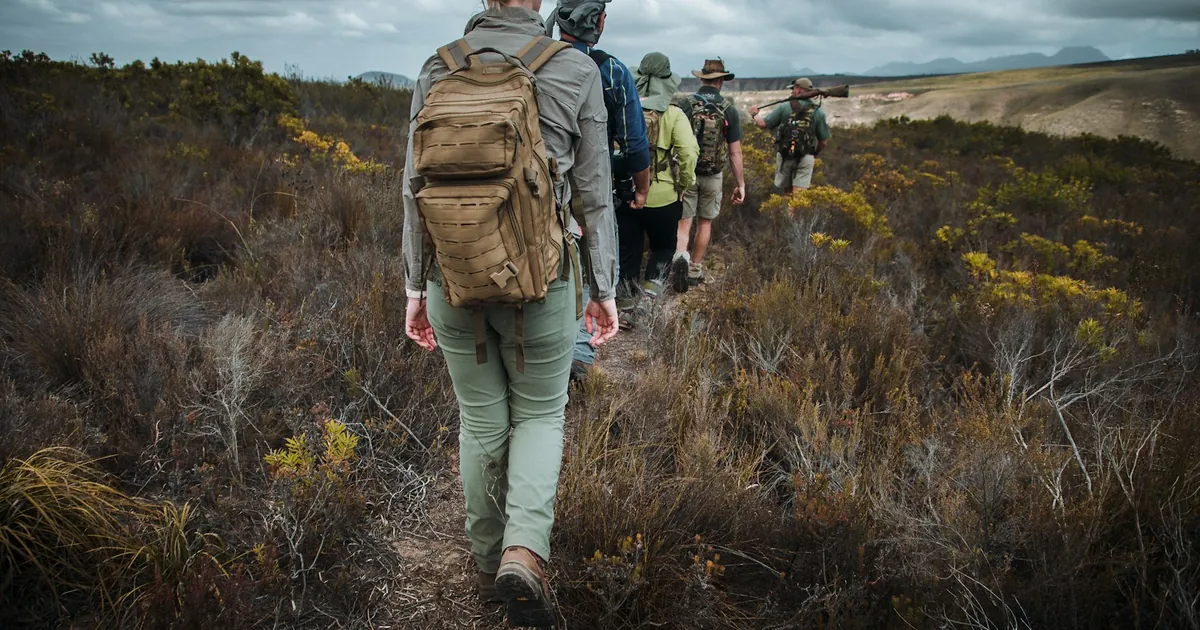
A walking safari restores your position within the landscape rather than above it. You move slowly, you stop frequently, and everything within arm's reach becomes interesting rather than irrelevant. Your guide reads the ground: a buffalo spoor from last night, still-fresh lion tracks, the claw marks on a termite mound, the broken grass stems where a leopard passed. You hear what you could not hear from a vehicle - the alarm call of a go-away bird marking a predator's location, the deep rumble of an elephant herd 500 metres away.
The scale of animals changes completely on foot. An elephant encountered at 40 metres when you are standing in the grass is physically overwhelming in a way that no vehicle-based sighting can replicate. Its smell, the sound of its digestion, the particular way it tracks you with its ears while chewing - these are details that only proximity on foot provides. This is not mere aesthetics. It changes how you understand the animal and its relationship to its environment.
Walking safaris are also the context in which guides demonstrate the full depth of their knowledge. Without the pressure to find the next large mammal sighting, a guide can stop at a spider web, crouch over a dung beetle, name every bird by its call, explain why a specific tree's bark is stripped at elephant-tusk height, and connect it all into a coherent picture of an ecosystem functioning in real time. It is a lesson in ecology that a game drive rarely delivers with the same depth.
Where Walking Safaris Operate
Walking safaris require a licensed professional walking guide, typically accompanied by an armed scout. They are offered at specific parks and operators with the appropriate licensing and training. The best destinations for walking safaris include:
- Zambia - South Luangwa National Park: The birthplace of the modern walking safari. South Luangwa has the highest concentration of qualified walking guides in Africa and some of the best walking safari operators in the business. The South Luangwa walking safari guide covers this destination in full detail.
- Zambia - Lower Zambezi National Park: Walking along the Zambezi River through miombo woodland and floodplain; often combined with canoe safaris.
- Zimbabwe - Mana Pools National Park: One of Africa's most celebrated walking safari destinations. The combination of riparian forest, open floodplain, and a high-density predator community makes Mana Pools exceptional on foot.
- Botswana - Khwai and Linyanti concessions: Some Botswana concession operators offer walking activities. The Okavango Delta itself is not easily walkable due to the water channels, but the drier concessions to the east and north offer excellent walking.
- South Africa - Kruger National Park: Several trails are available including the famous Wilderness Trails where groups of up to eight people spend two nights in fly camps deep in the park. Walking is also offered at many private reserves adjacent to Kruger.
- Kenya - Laikipia and some conservancies: Walking is offered in several of Kenya's northern conservancies with appropriate guide licensing.
Limitations of Walking Safaris
Walking safaris have genuine constraints that matter for planning. They are physically demanding - most cover three to six kilometres over two to four hours on uneven terrain, often in heat. They are not appropriate for visitors with mobility limitations, those with knee or hip problems, or children below the minimum age set by the operator (typically 12-16 years). They are also more season-dependent than game drives: dense wet-season vegetation significantly reduces sight lines and the effectiveness of the experience.
Wildlife coverage is less comprehensive on foot. A vehicle can scan ten times the area in the same time. Walking is slower, more targeted, and more likely to provide a handful of profound encounters rather than a long species list. This is a trade-off of depth for breadth, and for many visitors it is exactly the right trade. For others who want the maximum number of large mammal sightings in a limited time, the walking safari is not the priority activity.
How to Combine Both
The ideal safari for most visitors combines game drives and walking safaris rather than choosing between them. A typical structure:
- Morning game drive (pre-dawn to mid-morning): Cover ground, locate large mammals, follow predator activity. This is the highest-energy period of the animal day and when drives are most productive.
- Walking safari (early morning, separate from the drive): Some camps build walking into the activity rotation alongside drives, others offer it as a full-day option on dedicated walking days.
- Night drives: Available in many private reserves and concessions outside the formal national park system; night drives reveal nocturnal species (leopards, civets, genets, porcupines, hyenas) that are rarely seen by day.
South Luangwa is the single destination where walking is most fully integrated into the camp programme. A standard itinerary might include a morning walk, a rest and lunch break, a late afternoon drive, and a night drive - covering all the activity types in a single day. Spending at least one night at a remote bushcamp, walking between the main camp and the bushcamp over a full day in the field, is the defining South Luangwa experience.
Which Is Right for You?
Choose a game drive-focused safari if: you want to maximise species encounters, are visiting with children, have mobility limitations, or are visiting during the green season when walking is less effective.
Prioritise walking if: you are a returning Africa visitor who wants a deeper, more immersive experience; you are fit and enjoy hiking; you are interested in ecology and natural history as much as the large mammal checklist; or you specifically want to visit Zambia or Zimbabwe where walking is central to the safari culture.
For the great majority of visitors, the best answer is both. A safari itinerary that includes even one or two guided walks alongside the standard game drive programme will deliver a more complete and more memorable experience than either approach alone. Discuss with your operator or guide which parks and camps in your itinerary offer the best walking options and build at least one full walking morning into your schedule. You are unlikely to regret it.
To start planning your first safari - combining all the activity types and destination choices into a coherent itinerary - the first-time safari guide covers everything from destination selection to what to pack.