Safari in Namibia: A Guide to Etosha and Beyond
Published 26 October 2026
Why Namibia Is Different
Most safari-goers head to East or Southern Africa's more famous parks - the Masai Mara, the Serengeti, Kruger, the Okavango Delta. Namibia sits slightly apart from the primary safari circuit, and that is precisely its appeal. It is the least densely populated country in sub-Saharan Africa, with a landscape of extraordinary variety: the ancient orange dunes of the Namib, the flat white expanse of the Etosha Pan, the sculptured rock formations of Damaraland, and the coastal fog belt of the Skeleton Coast. It is also the only African country where self-drive safari is the dominant mode of wildlife travel, and where an independent visitor with a well-prepared 4x4 can access world-class wildlife without a guide.
Namibia has a strong legal and conservation framework that has produced one of Africa's notable wildlife recovery stories - particularly for lions, cheetahs, leopards, and the iconic black rhino. Community conservancies covering millions of hectares across the country have reversed decades of poaching by giving local communities a direct economic stake in wildlife protection.
Etosha National Park: The Heart of Namibian Safari
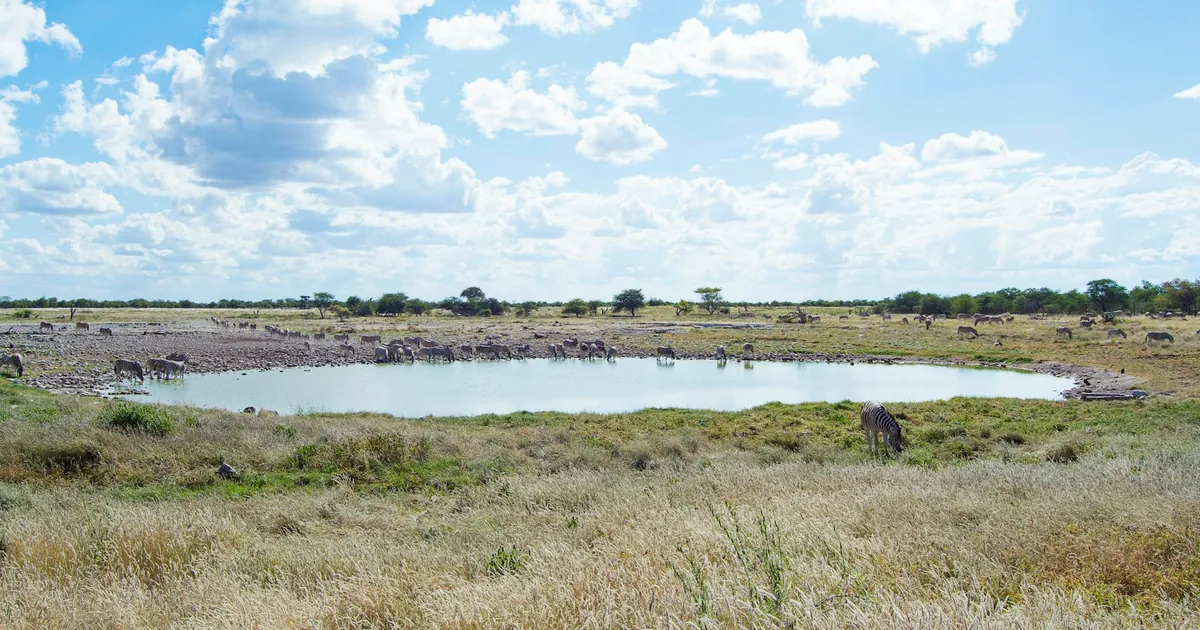
Etosha National Park is Namibia's most celebrated wildlife destination and one of the most unusual national parks in Africa. At the centre of the park lies the Etosha Pan - a vast, flat, saline depression covering roughly 4,760 square kilometres. For most of the year it is completely dry, shimmering in the heat haze as a blinding white expanse of salt and mineral crust. During wet years, it briefly floods with shallow water, attracting flamingos in extraordinary numbers. Around the edge of this pan, a series of waterholes - both natural and artificially maintained - attract wildlife in concentrations that are, by any measure, exceptional.
The genius of Etosha as a wildlife destination is its predictability. In the dry season (roughly May-October), water is available only at known waterholes, meaning every animal in the park must come to drink at one of them. A visitor who parks at a productive waterhole and waits patiently will almost certainly see elephants, zebras, springbok, oryx, kudu, giraffes, and - with luck - lions, leopards, cheetahs, and black rhinos within the space of a few hours. Some of the park's most productive waterholes are floodlit at night, allowing after-dark observation from adjacent camps. Sitting at the Okaukuejo or Halali waterholes after dark and watching elephants drink by moonlight is one of Africa's genuinely unique wildlife experiences.
Desert-Adapted Wildlife
Etosha's wildlife is not simply a replica of what you find in East African parks. Namibia sits at the edge of the Namib Desert - one of the oldest deserts on Earth - and many species have developed physiological and behavioural adaptations to aridity that are fascinating in their own right.
Desert-adapted elephants are the most famous. These are not a distinct subspecies, but populations of African savanna elephant that have developed longer travel ranges, lower water dependency, and diets that include more woody material and bark than their grassland counterparts. They are found mainly in Damaraland and the Hoanib Valley northwest of Etosha. Seeing them crossing red sand dunes or standing in dry riverbeds against stark rocky mountains is a visual experience unlike any conventional elephant sighting.
Black rhinos are another Namibian highlight. Etosha holds one of Africa's largest black rhino populations, and waterhole sightings - particularly at night - are more reliably achieved here than almost anywhere else on the continent. Namibia overall is one of the strongholds of black rhino recovery: the country's community-based conservation model has allowed rhino numbers to increase significantly since the 1990s. Our species profile on the gemsbok covers another of Namibia's iconic species - the bold, black-and-white oryx that appears on the Namibian coat of arms and is one of the most striking animals at Etosha's waterholes.
Lions in Etosha are well-adapted to the open, waterhole-centred landscape. Prides are commonly observed at waterholes, particularly at dawn when they may still be at the water's edge having hunted overnight. Cheetahs are present in the park but more commonly encountered in Namibia's private ranches and conservancies - including the farmlands of the south and the Waterberg Plateau area - where community programmes have established livestock compensation schemes that reduce farmer conflict.
How to Self-Drive Etosha
Self-driving Etosha is one of Africa's most accessible safari experiences. The park's gravel roads are good quality and passable in a standard 2x4 vehicle in the dry season (a high-clearance 4x4 is recommended but not strictly necessary on main routes). Speed limits inside the park are low, and the driving is relaxed. The primary strategy is simple: drive slowly between waterholes during the cool morning hours, spend the heat of the day at a shaded waterhole or resting at camp, and return to the waterholes in the late afternoon.
Entry is through one of the park's main gates (Andersson Gate in the south is the most commonly used). The park has three rest camps - Okaukuejo, Halali, and Namutoni - each with accommodation ranging from campsites to chalets, restaurants, shops, and crucially, floodlit waterholes within walking distance. Camping at Okaukuejo and watching the waterhole from the adjacent viewing area through the night (with multiple shifts if your enthusiasm holds) is one of the purest safari experiences available at any price point.
A minimum of three nights in Etosha is recommended to do justice to the park. Four to five nights allows a more relaxed circuit covering the eastern (wetter, more vegetation, better for kudu and woodland birds) and western (drier, better for lions and rhino) sections. For those combining self-drive independence with a guided element, some lodges just outside the park's boundaries offer guided game drives as an option alongside self-drive camp access.
The Best Time to Visit Etosha
The dry season - May through October - is unambiguously the best time to visit Etosha. As water disappears from temporary pans and riverbeds, wildlife concentrates at the permanent waterholes, making sightings more frequent and more predictable. July and August are the coldest months (nights can drop to near-freezing) but offer peak wildlife concentration and excellent photographic conditions. October, immediately before the rains return, is often the most dramatic - waterholes are at their most densely attended, lions are bolder and more active in daylight, and the sky turns extraordinary colours at dusk.
The wet season (November-April) brings different rewards: the Etosha Pan floods and attracts flamingos in large numbers; calving season brings young animals; and the park is uncrowded. But wildlife disperses widely when water is plentiful, making the waterhole-centric strategy less productive. Birding improves substantially during the wet season as Palaearctic migrants arrive.
Beyond Etosha: The Broader Namibian Safari
Namibia's wildlife experiences extend far beyond Etosha, and most visitors combine the park with at least one other region. The most popular combinations include:
- Damaraland: North-west Namibia's dramatic rock landscape, home to desert-adapted elephants and black rhinos in a wilderness setting. Community conservancy lodges here offer guided tracking on foot - exceptional for rhino encounters.
- The Skeleton Coast: The cold Atlantic coastline of north-western Namibia, one of the world's most remote and dramatic coastlines, supporting Cape fur seal colonies, brown hyenas, black-backed jackals, and occasional desert lions.
- Sossusvlei and the Namib: Though not a traditional wildlife destination, the ancient orange dunes of Sossusvlei and the dead trees of Deadvlei represent some of the most photographed landscapes on Earth. The Namib-Naukluft Park surrounding them is the world's oldest desert and home to desert-adapted oryx, springbok, and ostrich.
- Waterberg Plateau Park: A plateau rising above the surrounding plains and accessible only on foot, with buffalo, sable, roan antelope, and white rhinos - species not present in Etosha.
For those considering self-drive across multiple Namibian regions, our guide to self-drive vs guided safari covers the practical trade-offs: vehicle type, road conditions, trip planning, and when a guide genuinely adds value versus when you can navigate independently.
Practical Namibia Notes
Namibia is one of the easiest African countries to visit independently. English is widely spoken, road signage is good, and most main roads in the north and centre are compacted gravel in excellent condition. The country operates on South African Rand in addition to the Namibian Dollar (which trades at parity). Windhoek, the capital, is well served by direct flights from Frankfurt (Lufthansa), Johannesburg, and Cape Town, with connections onwards from those hubs.
Accommodation across Namibia ranges from basic campsites at NWR rest camps to some of Africa's most architecturally remarkable luxury lodges. The country has invested significantly in high-end safari tourism, and lodges such as those in the Damaraland community conservancy areas are frequently cited among the world's best safari properties. Book Etosha NWR camps well in advance for dry season visits - they fill months ahead.