Gorillas vs Chimpanzees: Africa's Great Apes Compared
Published 19 September 2026
Africa's Great Apes: An Introduction
Africa is home to two of humanity's four closest living relatives: the gorilla and the chimpanzee. Both are great apes - members of the family Hominidae, along with orangutans, bonobos, and humans - and both share striking cognitive and behavioural similarities with our own species. Watching either animal in its natural forest habitat produces an almost visceral sense of recognition, a feeling that you are looking at something fundamentally familiar even in an entirely wild context.
But despite sharing a continent and a family tree, gorillas and chimpanzees are very different animals. They occupy different ecological niches, live in different social systems, eat different diets, and require entirely different travel plans to observe. If you are choosing between a gorilla trek and a chimpanzee habituation experience, understanding those differences is essential to making the right decision for your safari.
Size and Physical Appearance
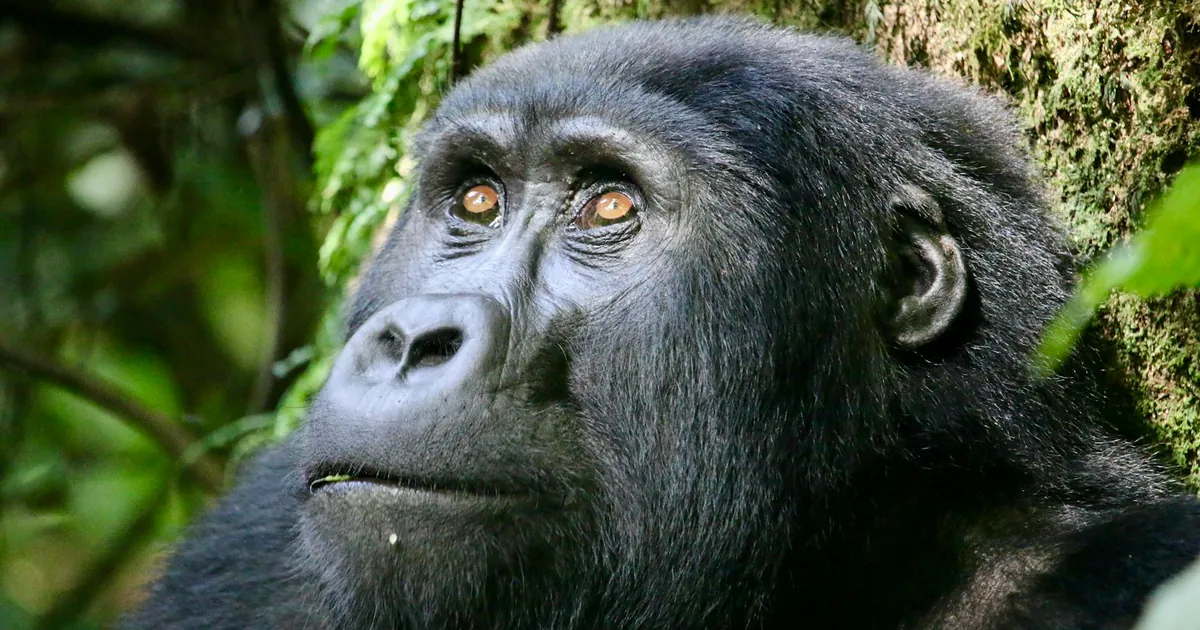
The most immediately obvious difference is size. Gorillas are the world's largest primates - substantially so. Adult male gorillas (silverbacks) typically weigh 160-200 kg and can reach 220 kg or more. They stand 1.7-1.8 metres tall. An arm span of over 2.5 metres gives them a reach that is simply extraordinary. Female gorillas are considerably smaller, typically 70-100 kg.
Chimpanzees are much smaller. Adult males typically weigh 40-60 kg, females 30-47 kg. They stand roughly 1-1.3 metres tall. While considerably more slender than gorillas, chimpanzees are extremely muscular for their size - research suggests they are significantly stronger than humans pound-for-pound, with muscle fibres optimised for power rather than endurance.
In the wild, the physical contrast during a sighting is striking. A silverback gorilla is genuinely imposing - a mountain of muscle and calm authority that sits in the undergrowth with an air of total, unhurried dominance. Chimpanzees are faster, noisier, and more visibly energetic; their forest communities feel busy and social in a way that gorilla groups do not.
Species and Subspecies
There are two gorilla species: the western gorilla (Gorilla gorilla) and the eastern gorilla (Gorilla beringei). Within the eastern gorilla, two subspecies are most relevant to safari-goers: the mountain gorilla (Gorilla beringei beringei), found only in the Virunga Massif (Uganda/Rwanda/DRC) and Bwindi Impenetrable Forest (Uganda), and the Grauer's gorilla (Gorilla beringei graueri), found in eastern DRC.
There is one chimpanzee species (Pan troglodytes) with four recognised subspecies distributed across equatorial Africa from Senegal to Tanzania. The closely related bonobo (Pan paniscus), sometimes called the pygmy chimpanzee, is a separate species found only in the DRC.
For most visitors, gorilla trekking means mountain gorillas in Uganda or Rwanda - the most accessible and habituated populations. Chimpanzee tracking in Uganda's Kibale Forest is the most popular chimp experience in Africa. Both Uganda and Rwanda offer world-class great ape tourism infrastructure.
Habitat
Western gorillas inhabit tropical and subtropical lowland rainforest in Central and West Africa. Mountain gorillas - the subspecies most frequently visited on treks - live at altitudes of 2,200-4,300 metres in the montane forest and bamboo zones of the Virunga volcanoes and Bwindi. These are cold, misty, physically demanding environments that require genuine hiking fitness to access.
Chimpanzees are considerably more habitat-flexible, occupying tropical rainforest, tropical dry forest, woodland, savanna-woodland mosaics, and forest fragments. Kibale Forest in Uganda - arguably the best chimp-tracking destination in Africa - is lowland tropical rainforest at comfortable altitude. The contrast in physical environment between gorilla and chimp trekking is one of the most important practical differences for trip planning.
Diet
Gorillas are primarily herbivores. Their diet is dominated by leaves, stems, bark, roots, and fruits depending on seasonal availability. Mountain gorillas eat almost no fruit (it is not widely available at high altitude) and subsist largely on vegetation - celery stalks, wild thistles, bamboo shoots, and fibrous leaves. This high-fibre, low-calorie diet requires enormous quantities of food, and gorillas spend much of the day eating or resting to allow digestion.
Chimpanzees are omnivores with a considerably more varied diet. They eat fruit (which makes up the bulk of their intake), leaves, seeds, insects (particularly termites), honey, and - importantly - meat. Chimpanzees are active hunters, pursuing and killing red colobus monkeys, bush pigs, and other small animals in coordinated group hunts. This carnivorous tendency, combined with the use of tools to extract termites and honey, represents a far more human-like dietary pattern than is seen in gorillas.
Social Structure
Gorilla groups (called troops) are typically led by a single dominant silverback and contain 5-30 individuals, including females, juveniles, and sometimes subordinate males. The silverback makes all movement decisions, mediates conflicts, and provides protection. Group life is generally calm; gorillas are not notably aggressive within the troop. Interactions between groups, however, can involve displays and occasional violence.
Chimpanzee social structure is more complex and more volatile. Chimps live in larger communities of 15-150 individuals organised around a dominance hierarchy among males. Males actively compete for status through alliance-building, displays, and physical aggression. Communities defend territories against neighbouring communities in what field researchers have described as "warfare" - systematic lethal raiding in which males patrol boundaries and attack rival community members. Within the community, intricate social dynamics, reconciliation behaviours, and coalition politics make chimpanzee society resemble a primate version of Machiavellian politics.
Tool Use and Intelligence
Both gorillas and chimpanzees demonstrate impressive cognitive abilities - but chimpanzees have a more extensive repertoire of tool use behaviours documented in the wild. Chimps use sticks to extract termites from mounds, rocks to crack open nuts, leaves as sponges to absorb water, and spears (sharpened sticks) to hunt bush babies in tree holes. Different chimpanzee communities have culturally distinct tool traditions - learned behaviours that are passed between generations. This cultural variation is considered one of the strongest pieces of evidence for non-human animal culture.
Western gorillas in captivity have learned sign language and demonstrated impressive cognitive abilities, but wild gorillas show less tool use than wild chimpanzees. Their high-calorie needs may make investment in complex foraging tools less necessary than it is for chimpanzees.
Conservation Status
Both species face serious conservation threats, though the picture varies by subspecies. Mountain gorillas are one of Africa's rare conservation success stories: from a low of around 620 individuals in 1989, the population has grown to an estimated 1,063 individuals (2018 census) - the only great ape subspecies to show population growth. Intensive anti-poaching, community conservation programmes, and the economic incentives of gorilla tourism have driven this recovery. The mountain gorilla is now classified as Endangered rather than Critically Endangered.
Grauer's gorillas and western gorillas remain Critically Endangered, primarily due to habitat loss, bushmeat hunting, and disease - particularly Ebola, which has had devastating impacts on western gorilla populations in Central Africa.
Chimpanzees are classified as Endangered, with an estimated 170,000-300,000 individuals remaining across their range. The primary threats are habitat loss (deforestation for agriculture and logging), bushmeat hunting, and disease (both human-transmitted respiratory illness and Ebola). Chimpanzee populations have been extirpated from several West African countries and continue to decline across much of their range.
Gorilla Trekking vs Chimpanzee Tracking: Which to Choose?
This is the practical question most visitors face when planning an East Africa itinerary. The short answer is: if budget and fitness allow, do both - they are utterly different experiences.
Gorilla trekking is typically more physically demanding (hiking through steep, wet montane forest), more expensive (gorilla permits in Uganda cost $700 USD, Rwanda $1,500 USD), and the encounter itself is extraordinary in its intimacy and gravitas. Sitting a few metres from a silverback in silent undergrowth is one of the most profound wildlife experiences on the planet.
Chimpanzee tracking is generally less physically demanding, less expensive, and the encounter is noisier, more energetic, and often faster-moving as chimps range through the canopy. Kibale Forest in Uganda is the gold standard for chimpanzee tracking, with habituated groups that tolerate human observers reliably. Our detailed guide to Uganda gorilla trekking covers everything you need to plan both experiences in a single country efficiently - Uganda offers the only place on Earth where you can trek for mountain gorillas at Bwindi and track chimpanzees at Kibale within a few hours' drive.
Key Differences at a Glance
- Size: Gorilla (silverback 160-220 kg) vs Chimpanzee (male 40-60 kg)
- Diet: Gorilla (primarily herbivore) vs Chimpanzee (omnivore, hunts meat)
- Social system: Gorilla (silverback-led troop, relatively stable) vs Chimpanzee (hierarchical community, political and volatile)
- Habitat: Gorilla (forest, mountain zones for mountain gorillas) vs Chimpanzee (diverse, lowland to montane)
- Tool use: Gorilla (limited in wild) vs Chimpanzee (extensive documented tool culture)
- Conservation: Mountain gorilla (Endangered, recovering) vs Chimpanzee (Endangered, declining)
- Best destination: Mountain gorilla (Uganda - Bwindi, Rwanda - Volcanoes NP) vs Chimpanzee (Uganda - Kibale, Tanzania - Mahale or Gombe)
Planning Your Great Ape Safari
Both gorilla permits and chimpanzee habituation permits must be booked well in advance - gorilla permits in particular sell out months ahead during peak season. The dry seasons (June-September and December-February) are the most popular and most comfortable for trekking, with less mud and better trail conditions.
Combining gorillas in Rwanda with a classic savanna safari in Kenya or Tanzania is one of the most popular high-end safari itineraries in East Africa. The contrast between the cold, dripping intimacy of a gorilla encounter in Bwindi and an open-vehicle sunrise game drive in the Masai Mara captures the full range of what African wildlife has to offer.
The mountain gorilla and chimpanzee species profiles on SafariPlnr provide detailed sighting windows, permit booking guidance, and the best lodges near both Bwindi and Kibale for combining the experiences in a single itinerary.