15 Facts About the Leopard: Africa's Most Elusive Big Cat
Published 4 March 2026
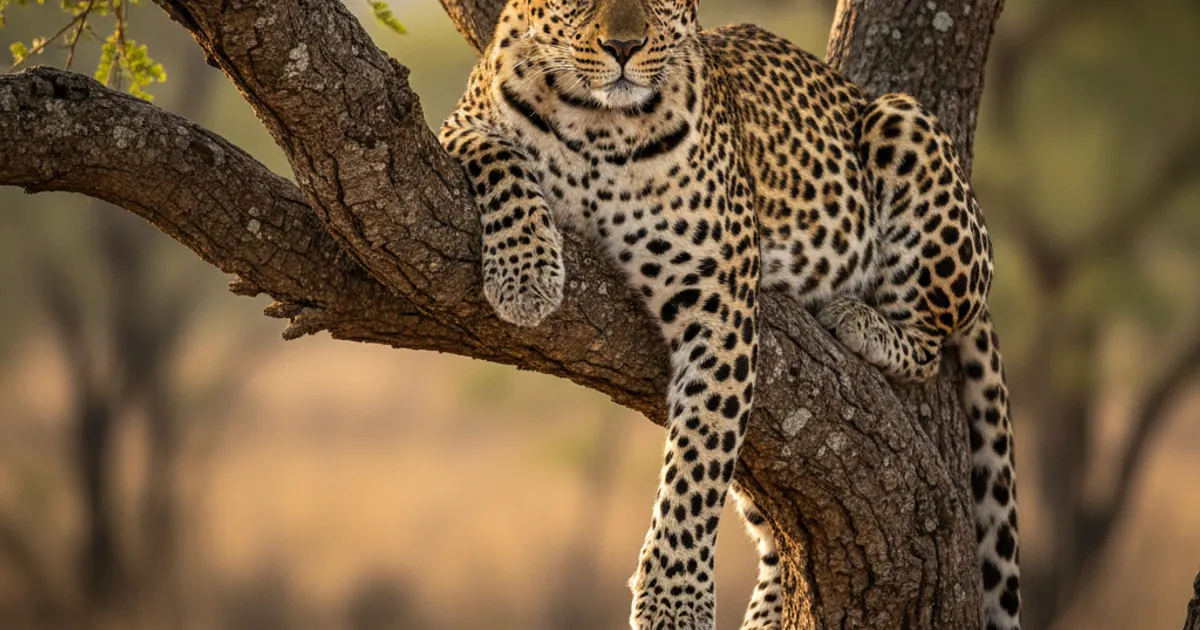
The Ghost of the African Bush
The leopard (Panthera pardus) is arguably the most adaptable of Africa's big cats. Found from the rainforests of West Africa to the deserts of Namibia, from sea level to snow-capped mountains at 5,600 metres, the leopard thrives in habitats that no other large predator can tolerate. Yet despite this remarkable range, leopards are notoriously difficult to see - their solitary nature, nocturnal habits, and extraordinary camouflage earn them the reputation as the most elusive of the Big Five.
The best parks for leopard sightings include Manyeleti Game Reserve and the Sabi Sands complex in South Africa, where habituated leopards provide exceptional viewing opportunities.
1. They Can Carry Prey Twice Their Weight Up a Tree
Leopards possess extraordinary strength relative to their size. A 60 kg leopard can hoist a 125 kg prey item - such as a young giraffe or adult impala - into the fork of a tree. They do this to protect their kills from lions and hyenas, which readily steal food from smaller predators. This tree-stashing behaviour is unique among African cats and one of the most dramatic sights on safari.
2. Their Rosettes Are Unique Fingerprints
Every leopard's coat pattern is unique, like a human fingerprint. The dark markings - called rosettes because they resemble roses - vary in size, shape, and spacing between individuals. Researchers use these patterns to identify and track individual leopards in camera trap studies. Leopards in forests tend to be darker than those in arid environments, an adaptation for blending into their specific habitat.
3. They're the Most Widespread Big Cat
Leopards have the largest range of any wild cat species, historically spanning Africa, the Middle East, and Asia. In Africa, they are found in virtually every habitat type except true desert. This adaptability stems from their catholic diet (they eat over 90 different prey species), solitary lifestyle, and willingness to live near human settlements - often without being detected.
4. Black Panthers Are Leopards
A "black panther" is simply a leopard (or jaguar) with melanism - an overproduction of melanin that turns the coat black. The rosette pattern is still present but can only be seen in certain lighting conditions. Melanistic leopards are most common in the dense forests of Southeast Asia, where their dark coats provide superior camouflage in low-light environments. They are rare but not unknown in Africa.
5. They're Ambush Predators Supreme
Unlike lions that rely on group hunting, leopards are solo ambush predators. They use stealth, patience, and explosive power to close the distance on prey. A leopard's stalk may last over an hour, creeping centimetre by centimetre through grass before launching from as close as 3 metres. The kill is typically a suffocating throat bite or a crushing bite to the back of the skull.
6. They're Surprisingly Vocal
Leopards produce a distinctive territorial call often described as the sound of a rough saw cutting through wood. This rasping, grunting call carries through the bush and is one of the most evocative sounds of the African night. Males call to advertise territory; females call to attract mates. Unlike lions, leopards rarely roar - their vocalisations are more varied and subtle.
7. Cubs Stay with Their Mothers for Two Years
Female leopards typically give birth to 2 to 3 cubs after a 96-day gestation period. Cubs are born blind and helpless, hidden in dense vegetation, rocky outcrops, or hollow trees. The mother moves her cubs frequently to avoid predators. Young leopards remain dependent on their mother for 18 to 24 months, during which they learn essential hunting and survival skills.
8. They Have Exceptional Night Vision
Leopards are primarily nocturnal, and their eyes are adapted for hunting in near-total darkness. Like other cats, they possess a tapetum lucidum - a reflective layer behind the retina that amplifies available light. Their night vision is estimated to be seven times more sensitive than human vision, allowing them to hunt effectively under starlight alone.
9. They're Expert Swimmers
Unlike most cats, leopards are strong swimmers and sometimes hunt fish and crabs. They readily cross rivers and have been observed swimming across wide water bodies. In the Okavango Delta, leopards wade through shallow floodplains in pursuit of prey and sometimes rest on islands surrounded by water.
10. They Kill the Most Livestock in Africa
Leopards' adaptability means they frequently come into conflict with livestock farmers. They kill more livestock across Africa than any other predator, which drives retaliatory killing - the single greatest threat to leopard populations outside protected areas. Community-based conservation programmes that compensate farmers for livestock losses have shown the most promise in reducing conflict.
11. Male Territories Overlap Multiple Females
Male leopards maintain large territories (30 to 78 square kilometres in prey-rich areas) that overlap the smaller ranges of several females. They patrol these territories constantly, marking with urine, scrapes, and claw marks. Territorial disputes between males can be fatal - scarred faces and torn ears are common among dominant males, testaments to violent encounters.
12. They Eat Almost Anything
Leopards are the most dietary-flexible of all big cats. Their prey ranges from dung beetles and rodents to adult eland weighing 900 kg. They regularly take impala, bushbuck, warthog, and monkeys, and will scavenge from other predators when the opportunity arises. This dietary flexibility is key to their survival in fragmented and degraded habitats.
Where to See Leopards on Safari
The best destinations for leopard sightings:
- Manyeleti Game Reserve & Sabi Sands, South Africa - habituated leopards with off-road driving
- Masai Mara, Kenya/Tanzania - excellent sightings especially along rivers and rocky outcrops
- Okavango Delta, Botswana - leopards adapted to delta waterways
- Yala National Park, Sri Lanka - highest density of leopards in the world
See our Best Parks for Leopards guide for detailed planning.