15 Facts About the Spotted Hyena: Africa's Most Misunderstood Predator
Published 26 March 2026
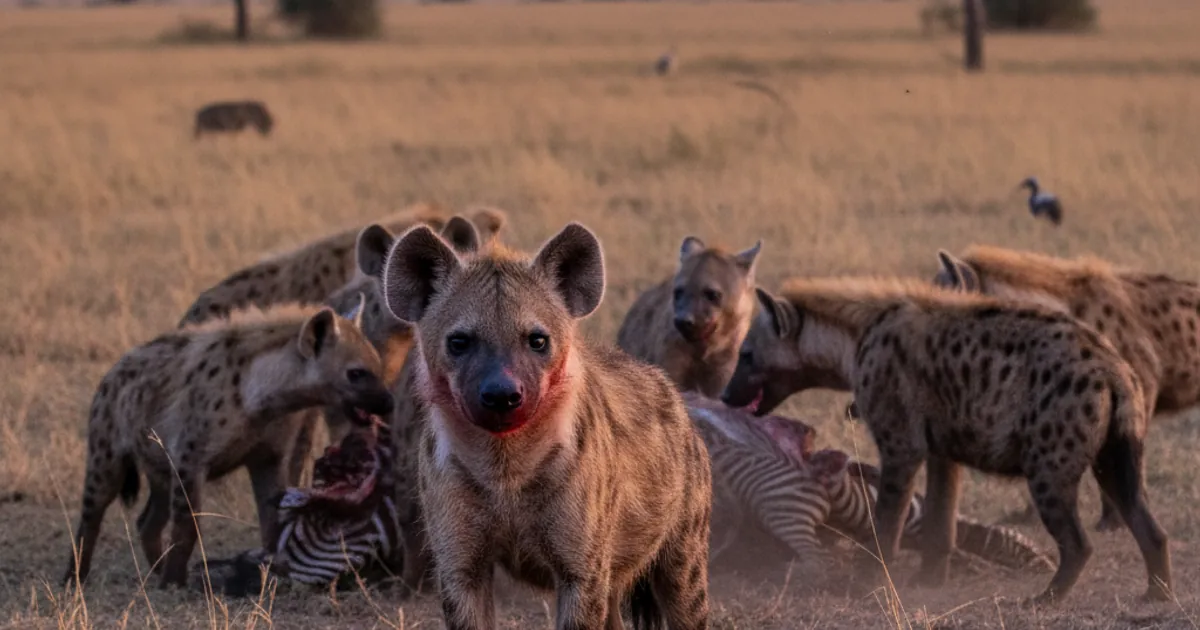
The Most Successful Large Predator in Africa
The spotted hyena (Crocuta crocuta) is Africa's most common large carnivore and arguably its most successful. With an estimated 27,000 to 47,000 individuals across sub-Saharan Africa, spotted hyenas outnumber lions by roughly three to one. Yet no animal is more misunderstood - decades of misleading portrayals have cast hyenas as cowardly scavengers, when in reality they are among the most intelligent, socially complex, and efficient predators on the continent.
1. They Kill Most of Their Own Food
Contrary to the popular myth, spotted hyenas are primarily hunters, not scavengers. In the Serengeti and Masai Mara, studies have shown that hyenas kill 60 to 95% of what they eat. It is actually lions that more frequently steal kills from hyenas (kleptoparasitism) rather than the other way around. Hyenas are endurance hunters, chasing prey at speeds up to 60 km/h over distances of several kilometres until the quarry collapses from exhaustion.
2. Their Jaws Are the Strongest of Any Mammalian Carnivore
Spotted hyenas possess jaw muscles and bone-crushing premolars that generate bite forces exceeding 1,100 PSI - the strongest of any mammalian predator relative to body size. They can crack open the femur of a giraffe and digest virtually every part of their prey, including bones, hooves, and horns. This bone-crushing ability means hyenas leave almost nothing behind at a kill site - a key reason they were historically labelled as scavengers (observers simply never found their kills).
3. They Live in Complex Female-Dominated Societies
Spotted hyena clans are matriarchal - the lowest-ranking female outranks the highest-ranking male. Clans can number 80 or more individuals, organised in strict linear hierarchies that are inherited through the mother's line. Cubs of high-ranking females enjoy priority access to food and grow faster than those of low-ranking mothers. This matriarchal system is unique among carnivores and has been compared to primate social structures.
4. They're Remarkably Intelligent
Cognitive studies have shown that spotted hyenas outperform chimpanzees in certain cooperative problem-solving tasks. They remember the rank, family relationships, and individual characteristics of every clan member - which can number over 80 individuals. Hyenas also demonstrate numerical assessment (counting enemies before engaging in territorial battles), social learning, and innovative foraging strategies.
5. Cubs Are Born With Their Eyes Open
Unlike most carnivores, spotted hyena cubs are born with their eyes open, with a full coat of dark fur, and with functional teeth. Siblings begin competing intensely from birth, and in same-sex litters, the dominant cub may kill its sibling within the first few weeks - a phenomenon called siblicide. This early aggression establishes dominance hierarchies that persist throughout life.
6. Their "Laugh" Is Actually a Stress Signal
The spotted hyena's famous "laugh" - a series of high-pitched giggling sounds - is not an expression of amusement. It is a vocalisation produced by subordinate hyenas during feeding competitions and social conflicts, signalling submission and nervous excitement. Hyenas have one of the most complex vocal repertoires of any carnivore, with at least 11 distinct calls used for communication.
7. They Can Digest Bone
Spotted hyenas have evolved a digestive system that can process virtually anything organic. Their stomach acid is so powerful (pH as low as 1) that they can digest bone, teeth, hooves, and horn within 24 hours. The only parts of prey that hyenas cannot digest are hair and the keratin of hooves, which are regurgitated as pellets. This digestive efficiency means hyenas extract maximum nutrition from every kill.
8. They Run in Relay
When hunting large prey like wildebeest or zebra, hyenas use a relay strategy. Fresh clan members take over the chase as others tire, maintaining relentless pressure over distances that can exceed 5 kilometres. This cooperative endurance hunting is devastatingly effective - prey animals simply cannot outrun the rotating pursuit.
9. They're More Closely Related to Cats
Despite their dog-like appearance, hyenas are more closely related to cats, civets, and mongooses than to dogs or wolves. The family Hyaenidae split from other feliforms roughly 30 million years ago, evolving their distinctive body plan independently. Their sloping back, powerful forequarters, and loping gait are adaptations for long-distance travel and carrying heavy prey rather than indications of canine ancestry.
10. Clan Wars Are Lethal
Territorial conflicts between hyena clans can escalate into full-scale battles involving dozens of animals. These "clan wars" are the hyena equivalent of primate intergroup conflict and can result in multiple fatalities. Clans patrol and scent-mark their boundaries obsessively, and intrusions are met with fierce collective aggression.
Where to See Spotted Hyenas on Safari
- Masai Mara - large clans frequently seen hunting and at den sites
- Ngorongoro Crater - enclosed population with frequent lion-hyena interactions
- Kruger National Park - common across the park, especially around water sources
- Moremi Game Reserve, Botswana - clans active across the delta fringes
Discover more predators in our Wildlife Directory and plan your trip with our Safari Cost Calculator.