12 Facts About the Hippopotamus: Africa's Most Dangerous Mammal
Published 12 September 2026
Meet the Hippo: More Than Meets the Eye
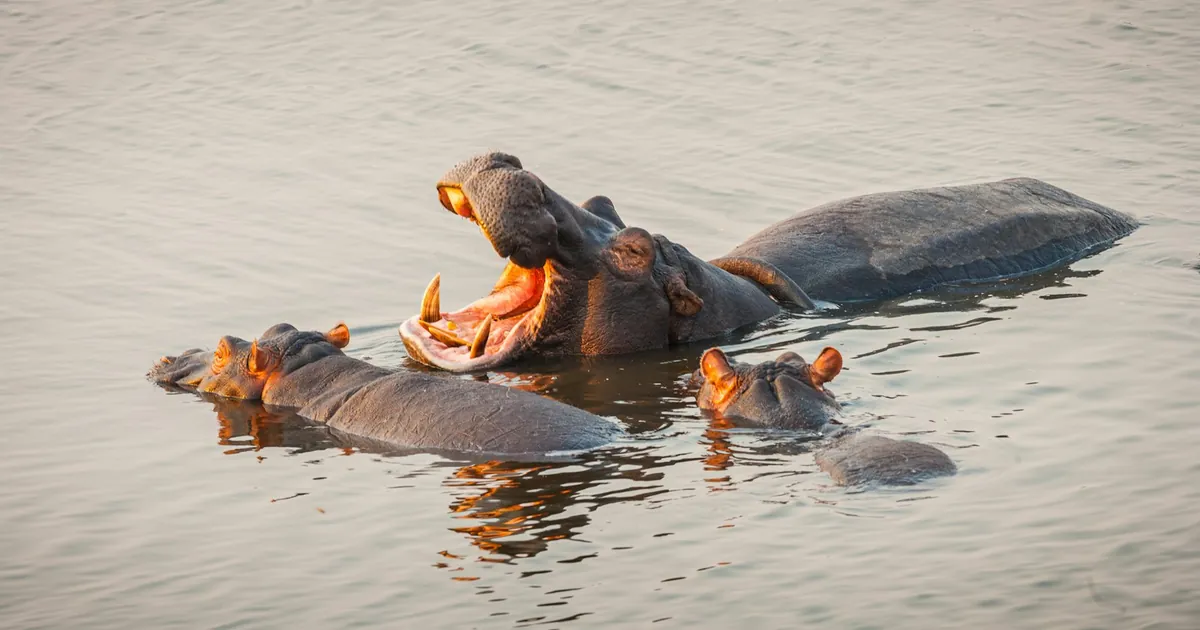
First-time safari-goers often underestimate hippos. Seen from a safe distance in a river or lake, wallowing with eyes half-closed and ears twitching lazily, they look like oversized, amiable bathtubs on legs. The reality is considerably more complex - and considerably more dangerous. Hippos are widely considered to be responsible for more human fatalities in Africa each year than any other large wild mammal, although reliable statistics are difficult to compile.
Understanding hippo behaviour - why they are territorial, why they emerge at night, how they communicate - transforms every sighting from a casual glance to a genuine wildlife insight. Here are twelve facts that will change how you look at Africa's most misunderstood megafauna.
1. Hippos Are the Third-Largest Land Mammals on Earth
Adult male hippos (bulls) typically weigh 1,500-3,200 kg and can reach up to 5 metres in length. Only elephants and rhinoceroses exceed them in bulk. Despite their enormous mass, hippos move with surprising agility both in water and on land. On flat ground, a hippo can sustain 30 km/h - fast enough to outpace a running human, and considerably faster than most people expect from an animal of this size.
2. They Are Not Actually Related to Pigs
The name "hippopotamus" comes from the Greek for "river horse," but hippos are neither horses nor pigs. Their closest living relatives are, strikingly, cetaceans - whales and dolphins. Genetic studies confirm that hippos and whales share a common ancestor that diverged approximately 55 million years ago. This makes the hippo the closest living land relative of the blue whale, a fact that remains genuinely astonishing even to biologists.
3. Hippos Are Largely Nocturnal Grazers
Despite spending their days submerged or resting at the water's edge, hippos are primarily terrestrial feeders. They emerge after dark to graze on short grasses, typically walking 5-10 km from water and consuming 35-50 kg of grass per night. Their grazing paths become well-worn tracks that persist for generations and are used by other animals. Dawn and dusk are the best times to observe hippos on the move between water and grazing areas.
4. The "Blood Sweat" Is Sunscreen and Antibiotic
Hippos have no sweat glands, but their skin secretes a reddish, oily fluid that was historically (and somewhat dramatically) described as "blood sweat." This secretion is neither blood nor sweat. It contains two unique pigments - hipposudoric acid (reddish) and norihipposudoric acid (orange) - that function as natural sunscreen blocking UV radiation and as broad-spectrum antibiotics inhibiting the growth of bacteria. The fluid also helps keep the skin moist. It is one of nature's more elegant solutions to the problem of sun exposure in a semi-aquatic animal with no fur coat.
5. They Are Highly Territorial in Water
Hippo pods are dominated by a single dominant bull that controls a stretch of riverbank or lakeshore - typically 100-500 metres of water. He defends this territory aggressively against rival males, using his enormous canine teeth (which can reach 50 cm in length) as weapons. Battles between bulls are violent and can be fatal. Subordinate males are tolerated within the territory provided they adopt submissive behaviour. Females and young move more freely between pods.
This territorial aggression is the root of hippo danger to humans. Canoes, kayaks, and small boats that enter a hippo's stretch of river are perceived as threats. The hippo charges in defence of territory, not as a predator, but the outcome for an overturned boat is equally perilous. Walking between a hippo and its water refuge on land is similarly dangerous.
6. South Luangwa Is One of the World's Best Places to See Hippos
The Luangwa River running through South Luangwa National Park in Zambia is renowned for having one of the highest concentrations of hippos on the African continent. The park's famous walking safaris - guided on foot through the bush - often involve close encounters with hippos at river crossings, which are managed carefully by experienced guides. The combination of abundant hippos, nile crocodiles (another riverine specialist), and excellent walking safari infrastructure makes South Luangwa uniquely compelling. Our detailed guide to South Luangwa walking safaris covers everything you need to know about planning this experience.
7. Hippos and Crocodiles Coexist Through Mutual Tolerance
In any hippo-inhabited river in Africa, nile crocodiles are almost invariably present in large numbers. The two species share space through a combination of mutual tolerance and careful avoidance. Crocodiles pose no threat to adult hippos (even large bulls can crush a crocodile with a bite from their powerful jaws) and rarely attempt to take calves. Hippos tolerate crocodiles basking on sandbanks nearby and may even allow them to shelter under their bodies in the water. The relationship is one of pragmatic coexistence rather than competition. For more on Africa's formidable crocodiles, see facts about the nile crocodile.
8. Hippo Communication Is Partly Underwater
When a hippo produces its characteristic honking wheeze-grunt call - one of the most recognisable sounds of an African night - it is often producing the same call simultaneously above and below the water. Studies have shown that hippos can close their nostrils and ears, produce calls that vibrate through the water column, and receive the same calls as both airborne sound and underwater vibration. This amphibious communication system allows individuals submerged to stay in contact with the broader pod.
9. Calves Are Born Underwater
Hippos give birth in shallow water rather than on land. Calves can swim before they can walk, instinctively surfacing to breathe. A newborn weighs 25-55 kg and must nurse underwater, surfacing every 30-40 seconds for air. Calves suckle both in water and on land, and are weaned after roughly eight months. Mothers are fiercely protective of calves against any perceived threat - including other hippos, crocodiles, and occasionally curious safari vehicles that come too close to the riverbank.
10. Hippos Create Aquatic Habitat for Other Species
The volumes of dung deposited by hippo pods enrich river and lake ecosystems substantially. A single hippo produces approximately 1 to 3 tonnes of dung per year. This fertilises aquatic vegetation, supports fish populations, and underpins broader aquatic food chains. Researchers have documented that rivers with healthy hippo populations support significantly greater fish biomass than comparable rivers without hippos. In this sense, hippos are a keystone species for aquatic ecosystems in exactly the way elephants are for terrestrial ones.
11. The Population Has Declined Sharply
The common hippopotamus is classified as Vulnerable on the IUCN Red List. Population estimates suggest roughly 115,000-130,000 individuals remain in the wild, down substantially from nineteenth-century numbers when hippos ranged throughout Africa including the Nile Delta. Hunting for ivory (hippo teeth were widely used as an ivory substitute), habitat loss through riverbank agriculture, and bushmeat hunting have all contributed to declines. Civil conflict in Central Africa has been particularly damaging, as the rule of law that protects parks and wildlife breaks down during prolonged instability.
12. Hippos Cannot Actually Swim - They Walk Underwater
This fact surprises virtually everyone. Despite being semi-aquatic animals that spend up to 16 hours per day in water, hippos do not swim in the traditional sense. They cannot float. They walk and bound along the riverbed, pushing off with their legs to surface for air every 3-5 minutes (longer if sleeping). Young hippos surface to breathe every 30-40 seconds. When a hippo appears to be swimming across a river, it is actually running along the submerged bottom in a kind of buoyant trot, only occasionally kicking off with all four feet to rise to the surface.
Where to See Hippos in the Wild
Hippos are widespread across sub-Saharan Africa wherever permanent rivers and lakes exist. The best viewing is always near water during daylight hours when the animals are resting, and along riverbanks at dusk when they emerge to graze. Top destinations include:
- South Luangwa National Park, Zambia - exceptional density along the Luangwa River
- Murchison Falls National Park, Uganda - boat safaris provide excellent close-range encounters
- Okavango Delta, Botswana - hippos in the reed-lined channels are a quintessential scene
- Serengeti/Masai Mara, Tanzania/Kenya - Mara River and Grumeti River pools hold large pods
- Kruger National Park, South Africa - Crocodile and Sabie rivers particularly productive
The key to safe hippo viewing is always maintaining distance, never positioning yourself between a hippo and water, and trusting your guide's judgment about safe approach distances. Treated with respect, the hippo is one of Africa's most fascinating wildlife encounters - an animal that rewards patience and close observation far more than a passing glance from a moving vehicle.