12 Facts About the Nile Crocodile: Africa's Apex Aquatic Predator
Published 19 March 2026
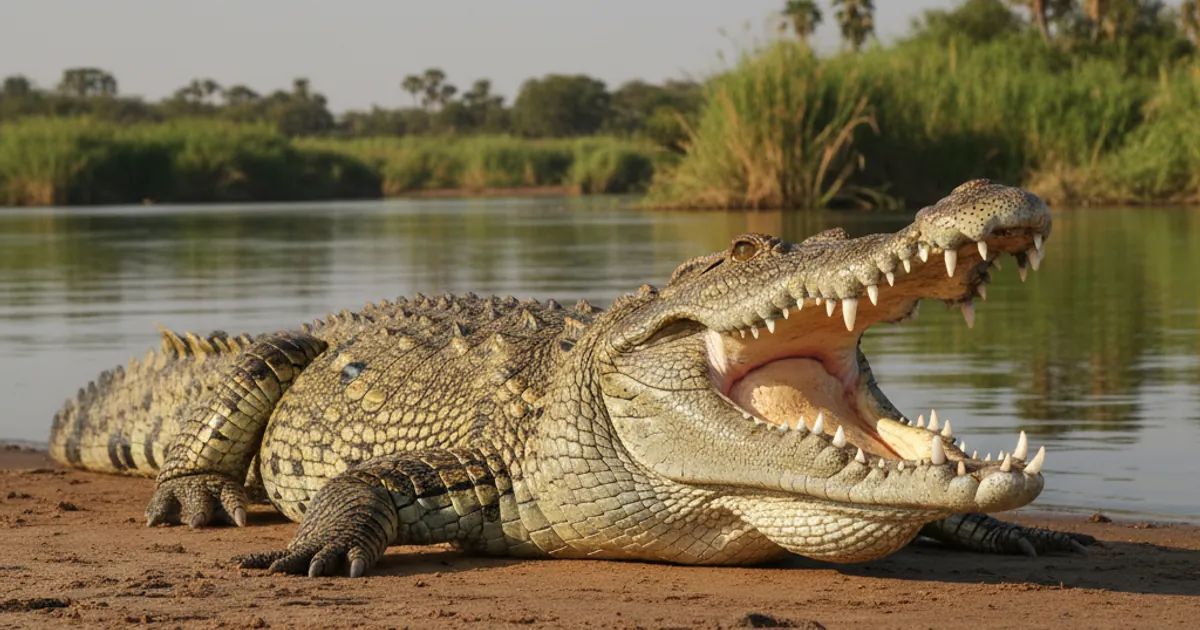
A Living Fossil
The Nile crocodile (Crocodylus niloticus) is one of the most feared animals in Africa - and with good reason. Growing up to 6 metres long and weighing over 1,000 kilograms, it is the continent's largest freshwater predator and has remained largely unchanged for 200 million years. Crocodilians survived the asteroid impact that wiped out the dinosaurs, and the Nile crocodile embodies that ancient resilience.
Found in rivers, lakes, and estuaries across sub-Saharan Africa, Nile crocodiles are present in virtually every waterway on the continent. They are commonly spotted at the Mara River during the wildebeest migration, where their ambush attacks on crossing herds are among the most dramatic scenes in nature.
1. They Have the Strongest Bite of Any Animal
The Nile crocodile's bite force has been measured at over 22,000 newtons - the most powerful bite of any living animal. For context, a lion's bite force is approximately 4,500 newtons. However, the muscles that open a crocodile's jaw are remarkably weak - a strong rubber band can hold a crocodile's mouth shut. This asymmetry is why crocodile handlers can control animals by securing the jaw.
2. They Cannot Chew
Despite their powerful jaws, crocodiles cannot chew. Their teeth are designed for gripping, not cutting or grinding. To dismember large prey, they perform the infamous "death roll" - clamping onto a limb and spinning their body to tear flesh away. Smaller prey items are swallowed whole. Crocodiles regularly swallow stones (gastroliths) that may aid digestion and serve as ballast for swimming.
3. Temperature Determines Their Sex
Unlike mammals, crocodile sex is not determined by chromosomes but by the temperature of the nest during incubation. Eggs incubated at 31.7 to 34.5°C produce males; temperatures above and below this range produce females. This temperature-dependent sex determination makes crocodiles particularly vulnerable to climate change, which could skew population sex ratios.
4. Mothers Are Surprisingly Tender
The fearsome Nile crocodile is actually one of Africa's most devoted mothers. Females guard their nests aggressively for the 90-day incubation period, rarely feeding. When the hatchlings begin to call from inside their eggs, the mother carefully digs them out and carries them to water in her mouth - the same jaws capable of killing a buffalo. She protects her young for several months after hatching.
5. They Can Hold Their Breath for Two Hours
Nile crocodiles are superbly adapted for aquatic ambush hunting. They can hold their breath for up to two hours while lying submerged, waiting for prey to approach the water's edge. Special valves close their nostrils and throat, and their heart rate slows dramatically during dives, conserving oxygen. Only their eyes, ears, and nostrils protrude above the surface - making them virtually invisible.
6. They Kill More Humans Than Any Other Large Animal
Nile crocodiles are estimated to kill 200 to 1,000 people per year across Africa, more than any other large animal including lions, elephants, or hippos. Most attacks occur in rural areas where people wash, fish, and collect water from crocodile-inhabited rivers. The true number is likely higher, as many attacks in remote areas go unreported.
7. They're Ambush Specialists
A hunting crocodile uses the water's surface as concealment, approaching prey with only millimetres of its head exposed. When within striking distance - typically 1 to 2 metres - it explodes from the water with a burst of speed that can exceed 12 km/h, seizing the prey and dragging it underwater. Drowning is the typical cause of death for large prey items.
8. They Live for Over 70 Years
Nile crocodiles are among the longest-lived reptiles, with lifespans exceeding 70 years in the wild. Some individuals are believed to reach 100 years. Unlike mammals, crocodiles exhibit indeterminate growth - they continue growing throughout their lives, though growth slows significantly after reaching sexual maturity at 12 to 16 years.
9. They're Essential Ecosystem Engineers
Crocodiles play crucial ecological roles beyond predation. Their burrowing creates water holes that sustain other species during droughts. Their nutrient-rich faeces fertilise aquatic ecosystems. By controlling fish and turtle populations, they maintain aquatic food web balance. The removal of crocodiles from ecosystems has been shown to cause cascading ecological disruptions.
10. Their Eyes Glow Red at Night
Crocodile eyes contain a tapetum lucidum - the same reflective structure found in cat eyes - that shines bright red when illuminated by torchlight. Safari guides often spotlight rivers at night, and the eerie red glow of crocodile eyes dotting the water surface is a memorable and slightly unnerving experience. The number of glowing eyes often reveals just how many crocodiles inhabit a seemingly quiet river.
11. They Survived Five Mass Extinctions
Crocodilians have existed for approximately 240 million years, surviving all five major mass extinction events including the Cretaceous-Paleogene event that ended the dinosaurs. The Nile crocodile's body plan has remained remarkably stable over this period - a testament to the effectiveness of its design. Modern crocodiles are essentially living fossils.
12. Conservation Has Been a Success Story
After decades of uncontrolled hunting for their valuable skin, Nile crocodile populations collapsed across much of Africa by the 1960s. Strict international trade regulations under CITES, combined with sustainable farming programmes, have allowed wild populations to recover significantly. The species is now classified as Near Threatened rather than Endangered - a rare conservation success story for a species that was once facing extinction.
Where to See Nile Crocodiles on Safari
- Mara River, Kenya/Tanzania - spectacular predation during the wildebeest migration (July-October)
- Chobe River, Botswana - large populations visible on boat safaris
- Murchison Falls, Uganda - enormous crocodiles below the falls
- Kruger National Park, South Africa - common along the Sabie and Olifants rivers
Explore more predator species in our Wildlife Directory.