15 Fascinating Facts About the Ostrich: Africa's Largest Bird
Published 4 February 2026
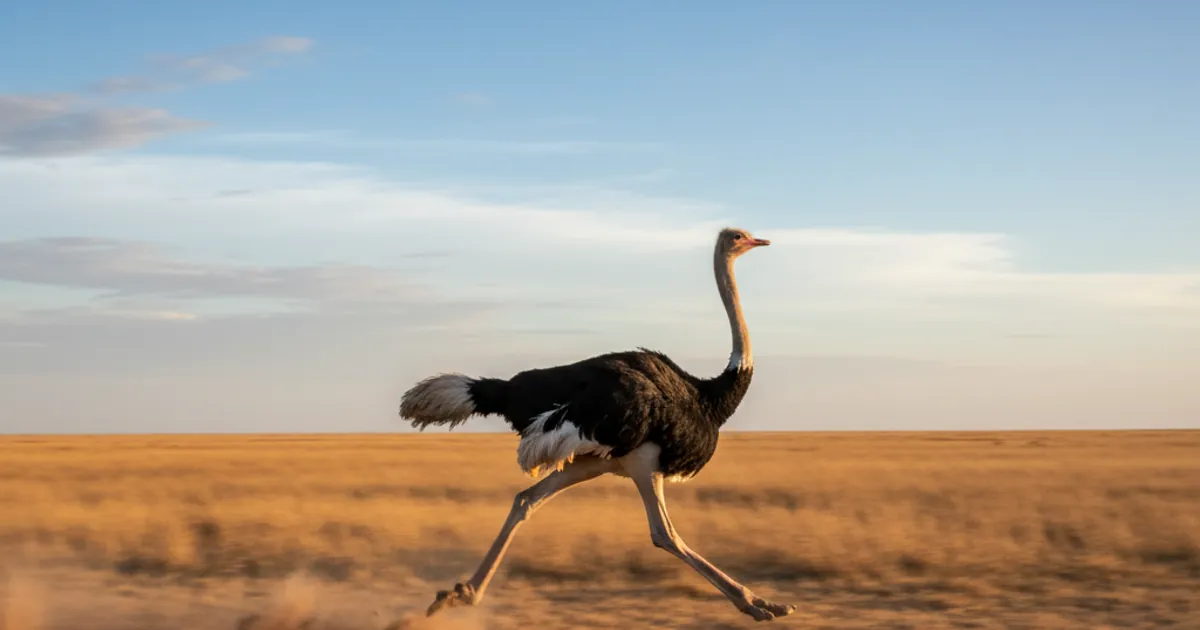
The World's Largest Living Bird
The common ostrich (Struthio camelus) stands up to 2.7 metres tall and weighs as much as 156 kilograms, making it the largest and heaviest living bird on the planet. Despite being flightless, the ostrich is a marvel of evolutionary engineering - built not for the skies but for the African savanna, where speed, endurance, and keen eyesight matter far more than flight.
Ostriches are found across sub-Saharan Africa, from the open grasslands of Kenya's Masai Mara to the arid plains of Nairobi National Park and the fynbos-fringed reserves of South Africa's West Coast National Park. They are one of the most commonly spotted birds on any African safari.
1. They Can Sprint at 70 km/h
Ostriches are the fastest birds on land and the fastest two-legged animals on Earth. They can sustain speeds of 50 km/h over long distances and reach bursts of up to 70 km/h when threatened. Each stride covers 3 to 5 metres. This speed makes them virtually uncatchable by most predators - even cheetahs prefer easier prey.
2. Their Eyes Are Bigger Than Their Brains
An ostrich's eye measures nearly 5 centimetres in diameter - the largest of any land vertebrate. These enormous eyes give them exceptional long-distance vision, allowing them to spot predators like lions and leopards from kilometres away. Their eyeballs are, famously, larger than their brains.
3. They Don't Actually Bury Their Heads in Sand
The myth that ostriches bury their heads in sand when frightened is entirely false. When threatened, ostriches either run or lie flat on the ground with their necks extended, making their profile resemble a mound of earth from a distance. This defensive posture likely gave rise to the myth. In reality, ostriches are alert and aggressive when cornered - their powerful legs can deliver lethal kicks.
4. Their Eggs Are the Largest of Any Living Bird
A single ostrich egg weighs approximately 1.4 kilograms - equivalent to about 24 chicken eggs. Despite being the largest egg laid by any living bird, it is actually the smallest egg relative to the size of the adult. The shell is remarkably strong, able to support the weight of a person standing on it, and has been used as water containers by indigenous San people for thousands of years.
5. Males Perform Elaborate Courtship Dances
During breeding season, male ostriches perform a striking courtship display. The male drops to his knees, spreads his dramatic black-and-white wing plumage, and sways his body rhythmically from side to side while bobbing his head. The display can last several minutes and is designed to attract multiple females, as ostriches are polygamous.
6. Both Parents Share Incubation Duties
Ostrich parenting is a team effort with a clever twist. The dominant female lays her eggs in a communal nest - a simple scrape in the ground - alongside eggs from subordinate females. But the dominant female can identify her own eggs and positions them in the centre, where they receive the most warmth. The female incubates during the day (her dull brown plumage provides camouflage), while the male takes the night shift (his black feathers blend into the darkness).
7. They Have Only Two Toes
Ostriches are the only birds with just two toes on each foot. The larger inner toe bears a formidable nail that resembles a hoof, while the smaller outer toe has no nail. This two-toed arrangement is an adaptation for speed - it provides better grip and reduces ground contact, functioning much like a sprinter's running spikes.
8. Their Kick Can Kill a Lion
When cornered, ostriches fight with devastating forward kicks. Each kick delivers a force of roughly 2,000 pounds per square inch, powered by muscular legs that account for a significant proportion of their body weight. The large toe nail acts like a claw, capable of disembowelling a predator. Lions, hyenas, and even humans have been killed by ostrich kicks.
9. They Swallow Stones to Help Digestion
Like many birds, ostriches lack teeth. They swallow small stones and pebbles - called gastroliths - which sit in their gizzard and help grind up tough plant material. An adult ostrich may carry up to 1 kilogram of stones in its digestive system at any given time.
10. They're Surprisingly Social
Ostriches are gregarious birds that typically live in groups of 5 to 50 individuals. During the non-breeding season, larger flocks sometimes form, occasionally mixing with gemsbok, zebras, and other grazers. This mixed-species herding provides mutual benefits - ostriches contribute their exceptional eyesight, while other animals provide additional vigilance.
11. Two Distinct Species Exist
Until recently, all ostriches were considered a single species. However, genetic studies have revealed that the Somali ostrich (Struthio molybdophanes) - found in the Horn of Africa - is a distinct species with blue-grey neck skin rather than pink. The common ostrich (Struthio camelus) has several subspecies, including the North African, Masai, and South African varieties.
12. They Can Survive Without Water for Days
Ostriches are superbly adapted to arid environments. They obtain much of their water from the plants they eat and can survive for several days without drinking. When water is available, they drink enthusiastically. Their kidneys are highly efficient at conserving water, and they can tolerate body temperature fluctuations that would be dangerous for most mammals.
13. They Were Once Farmed for Their Feathers
In the 19th century, ostrich feathers were among the most valuable exports from southern Africa, worth more per kilogram than gold. The feather boom centred on Oudtshoorn in South Africa's Klein Karoo, where elaborate "feather palaces" were built by wealthy ostrich barons. The industry collapsed after World War I when fashion shifted away from elaborate feathered hats, but ostrich farming continues today for meat, leather, and eggs.
14. Their Conservation Status Is Near Threatened
The IUCN classifies the common ostrich as Near Threatened. While populations in southern and eastern Africa remain relatively healthy - bolstered by farming and game reserves - wild ostrich numbers have declined significantly across North and West Africa. The Somali ostrich is listed as Endangered due to hunting and habitat loss.
15. They're a Safari Highlight You'll Never Forget
Encountering a wild ostrich on safari is a memorable experience. Males in breeding plumage are strikingly handsome, with jet-black body feathers contrasting with pure white wing and tail plumes. Watch for their courtship dances during the breeding season (typically March to September in East Africa), and keep your distance - a startled ostrich is capable of outrunning your safari vehicle.
Where to See Ostriches on Safari
Ostriches are widespread across African savannas and semi-arid regions. Top parks for ostrich sightings include:
- Masai Mara National Reserve, Kenya - large populations across the open grasslands
- Nairobi National Park, Kenya - easily spotted on day trips from Nairobi
- West Coast National Park, South Africa - breeding populations in the fynbos
- Etosha National Park, Namibia - common around waterholes
- Ngorongoro Conservation Area, Tanzania - frequently seen on the crater rim
For more African wildlife encounters, explore our Wildlife Directory or check our Best Parks for Wildlife guides.