10 Facts About the Giraffe: The Tallest Animal on Earth
Published 19 August 2026
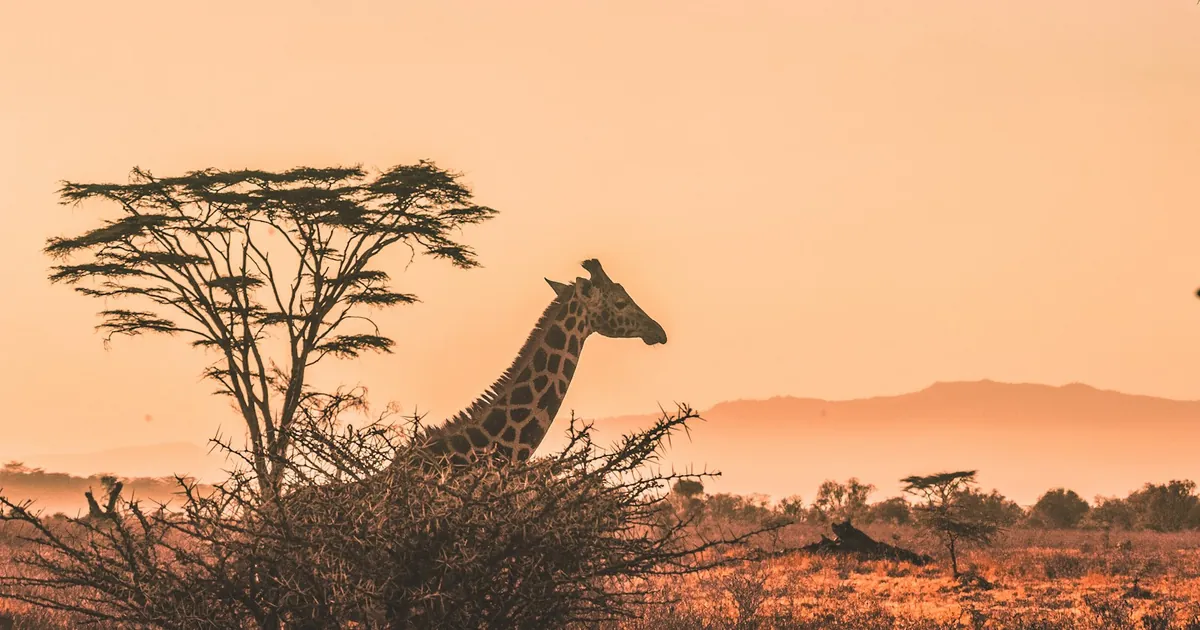
The Giraffe: Iconic, Misunderstood, and Under Threat
Few animals are more instantly recognisable than a giraffe browsing in an acacia-dotted savanna. The silhouette - that improbable neck, those gentle sloping shoulders, the slow, rolling gait - has become one of the most iconic images in all of nature. Yet for an animal so familiar, the giraffe remains poorly understood by most people, and its conservation situation is considerably more serious than its ubiquity in logos and children's books would suggest.
For safari-goers in Kenya and across East Africa, giraffes are frequently the most commonly sighted large mammal, visible from virtually every road in the savanna regions. Their abundance can breed a kind of casual familiarity. These ten facts are designed to restore a sense of wonder - and a sense of urgency - to every giraffe sighting.
1. Giraffes Are the Tallest Living Animals on Earth
Adult male giraffes (bulls) reach heights of 5-5.8 metres, with the neck alone accounting for up to 2.4 metres of that total. Adult females (cows) are shorter, typically 4.3-5.2 metres. At this height, a giraffe can comfortably browse foliage 6 metres from the ground - food sources entirely inaccessible to competing herbivores. This dietary niche is the most commonly cited explanation for the evolution of the long neck, though competition for mates (where neck length determines fighting success) is increasingly recognised as an equally important driver.
2. There Are Now Recognised to Be Four Distinct Species
For most of scientific history, all giraffes were considered a single species with several subspecies. A landmark 2016 genetic study revised this view, proposing that there are four distinct species: the northern giraffe (Giraffa camelopardalis), the southern giraffe (Giraffa giraffa), the Masai giraffe (Giraffa tippelskirchi), and the reticulated giraffe (Giraffa reticulata). This split has not been universally accepted - some authorities retain the single-species model with multiple subspecies - but the genetic evidence for significant divergence is compelling, with practical implications for conservation funding and priority-setting.
For Kenya visitors, the Masai giraffe (distinguished by jagged, irregular brown patches) is the most commonly encountered, while the reticulated giraffe (large polygonal patches separated by narrow white lines) is found in the north of the country. The giraffe species profiles on SafariPlnr detail where to find each type.
3. The Heart Must Work Exceptionally Hard
Pumping blood from the heart up a neck that may be over 2 metres long to the brain requires extraordinary cardiovascular power. A giraffe's heart is roughly 60 cm long and weighs around 11 kg - two to three times the weight of a human heart. It generates blood pressure approximately twice that of most mammals. Yet when the giraffe lowers its head to drink, a complex system of valves and elastic blood vessels prevents a catastrophic surge of blood to the brain - a problem that would be instantly fatal in any animal without this specialised anatomy.
4. Drinking Is Dangerously Awkward
Because the giraffe's legs are nearly as long as its neck, drinking requires spreading the front legs very wide or bending them at the knee to lower the mouth to water level. Both postures take several seconds to assume and several more to exit - a period of near-total vulnerability to predators, particularly lions and crocodiles at river crossings. Giraffes minimise this risk by drinking infrequently (they obtain much of their water from foliage), drinking in groups, and approaching water with obvious wariness. Witnessing a giraffe drink is a safari highlight precisely because of this vulnerability - it is one of the few moments when Africa's most visible megafauna looks genuinely uncertain of itself.
5. Giraffes Sleep Less Than Almost Any Other Mammal
Giraffes sleep an average of just 30 minutes to 2 hours per day, in short intervals of a few minutes at a time, making them one of the most sleep-deprived mammals in the animal kingdom. They rarely lie down; when they do, they fold their legs beneath their enormous body in a position from which rising takes several awkward seconds - again exposing them to predation. Much of their sleep is taken standing up. The evolutionary pressure to remain vigilant in predator-rich environments appears to have driven sleep requirements to the absolute physiological minimum.
6. Their Ossicones Are Not Horns
The horn-like protrusions on a giraffe's head are technically ossicones - bony protuberances covered with skin and fur, rather than true horns (which are keratin over a bone core) or antlers (which are shed annually). Both males and females carry ossicones from birth, though in males they are typically larger and baldened at the tips due to use in combat. Male giraffes also often develop a central ossicone and sometimes additional bony growths on the forehead as they age. The ossicones of young giraffes are flat at birth to ease passage through the birth canal, then harden and fuse to the skull within the first week.
7. "Necking" Is How Males Compete
Male giraffes determine dominance through a form of combat called "necking," in which two bulls swing their long necks like pendulums and strike each other with their ossicones. These blows can be powerful enough to knock an opponent off balance and, in extreme cases, to kill. The force generated by a large male's neck swing is considerable; the skull is the primary weapon, and the neck's length amplifies the momentum of each blow. Dominant males win the majority of mating opportunities, creating strong selection pressure for longer, more muscular necks in males.
8. Their Tongue Is Specially Adapted
A giraffe's tongue is around 45-50 cm long, deeply pigmented in dark purple or black (believed to protect it from UV sunburn during the hours spent exposed while browsing), and extraordinarily prehensile. Giraffes use it to strip leaves from thorny acacia branches, navigate around 5 cm-long spines without injury, and even to groom their own faces and ears. The tongue works in concert with a long, flexible upper lip to give the giraffe a remarkable reach into foliage that would shred the mouth of most other browsers.
9. Giraffes Are Largely Silent - But Not Completely
Giraffes were long believed to be mute. This is incorrect - they simply communicate at very low volumes and low frequencies. They hum, grunt softly, and occasionally produce a flute-like whistle or cough-bark as an alarm. Research published in 2015 identified a sustained humming vocalization produced at night that may serve as a form of contact call within the group. The near-silence of giraffes in the wild makes the occasional grunt or alarm snort all the more striking when it occurs.
10. The Population Has Fallen Dramatically
Giraffe numbers have declined by roughly 40% over the past three decades, from an estimated 155,000 animals in the late 1980s to around 97,000 today. The species is now classified as Vulnerable on the IUCN Red List. Some subspecies - particularly the Nubian giraffe and the West African giraffe - are Critically Endangered. Habitat loss, civil conflict, and hunting for meat and hides are the primary drivers of the decline. The situation has been described as a "silent extinction" because it receives far less attention than the more headline-generating crises facing elephants and rhinos.
Greater kudus, another of Africa's most elegant large browsers, face some of the same pressures from habitat fragmentation. For a deeper look at another distinctive African antelope, the greater kudu facts guide makes an excellent companion read.
Where to See Giraffes on Safari
Giraffes inhabit savanna, woodland, and semi-arid shrubland across sub-Saharan Africa. They are absent from dense rainforest and very arid desert but present in most other African biomes from South Africa to the Sahel. Top destinations include:
- Nairobi National Park, Kenya - Masai giraffes visible against the city skyline
- Samburu National Reserve, Kenya - reticulated giraffes with beautiful pale, polygon markings
- Serengeti, Tanzania - Masai giraffes in great numbers across the plains
- Etosha, Namibia - Angola giraffes gathered at waterholes
- Kruger National Park, South Africa - South African giraffes throughout the savanna zones
For the best time to visit Kenya - and when giraffes (among dozens of other species) are most reliably visible - the best time to visit the Masai Mara guide gives a detailed month-by-month breakdown of what to expect across the Mara ecosystem.
However familiar they may seem from photographs and documentaries, watching a giraffe move at full gallop - the front and back legs of the same side swinging forward together in a rocking canter unlike any other animal - is one of those wildlife moments that defies all expectation. Plan to be surprised.