Where to see Yellow-tailed Black-Cockatoo
The parks with the most verified sightings, out of 200+ safari areas where it has been recorded.
- 1Canunda National ParkOccasionalLodges
Victoria & Western NSW Riverlands, Australia · Occasional
- 2Mount William National ParkRareLodges
Tasmania & Bass Strait Islands, Australia · Rare
- 3Mornington Peninsula National ParkRareLodges
Victoria & Western NSW Riverlands, Australia · Rare
- 4Deep Creek National ParkRareLodges
Red Centre & Outback South Australia, Australia · Rare
- 5Bingera National ParkRareLodges
Central & Southern Queensland, Australia · Rare
Common: 500+ verified sightings. Occasional: 50 to 499. Rare: under 50.
Yellow-tailed Black-Cockatoo: FAQs
Where can you see Yellow-tailed Black-Cockatoo on safari?
The parks with the most research-grade GBIF and iNaturalist records of Yellow-tailed Black-Cockatoo are Canunda National Park, Mount William National Park and Mornington Peninsula National Park. It is recorded in 200+ safari areas in all.
Is the yellow-tailed black-cockatoo endangered?
The IUCN Red List assesses the yellow-tailed black-cockatoo as Least Concern.
Spotted something wrong? Suggest a correction
About the yellow-tailed black-cockatoo
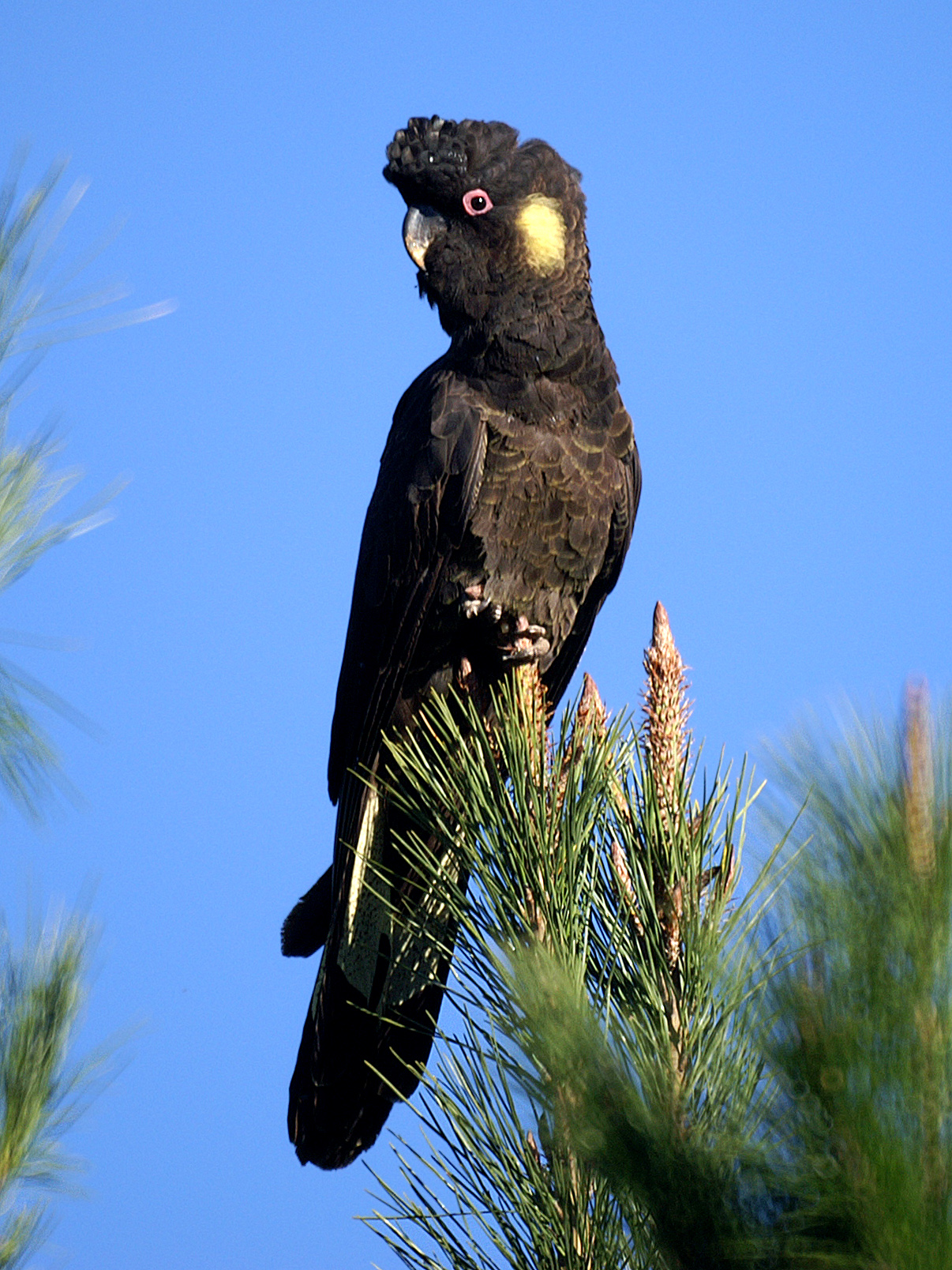
The yellow-tailed black cockatoo is a large cockatoo native to the south-east of Australia measuring 55–65 cm (22–26 in) in length. It has a short crest on the top of its head. Its plumage is mostly brownish black and it has prominent yellow cheek patches and a yellow tail band. The body feathers are edged with yellow giving a scalloped appearance. The adult male has a black beak and pinkish-red eye-rings, and the female has a bone-coloured beak and grey eye-rings. In flight, yellow-tailed black cockatoos flap deeply and slowly, with a peculiar heavy fluid motion. Their loud, wailing calls carry for long distances. The yellow-tailed black cockatoo is found in temperate forests and forested areas across south and central eastern Queensland to southeastern South Australia, including a very small population persisting in the Eyre Peninsula. Two subspecies are recognised, although Tasmanian and southern mainland populations of the southern subspecies xanthanotus may be distinct enough from each other to bring the total to three. Birds of subspecies funereus have longer wings and tails and darker plumage overall, while those of xanthanotus have more prominent scalloping. The subspecies whiteae is found south of Victoria to the East of South Australia and is smaller in size.
Adapted from Wikipedia, CC BY-SA 4.0.