Where to see Black-and-yellow Broadbill
The parks with the most verified sightings, out of 105 safari areas where it has been recorded.
- 1Tunku Abdul Rahman National ParkRareLodges
Sarawak, Malaysian Borneo, Malaysia · Rare
- 2Hutan Simpanan Kekal Gunung LesongRareLodges
Southern Peninsular Malaysia, Malaysia · Rare
- 3Hutan Simpanan Kekal Labis TambahanRarePark
Southern Peninsular Malaysia, Malaysia · Rare
- 4Hutan Simpanan Kekal Labis TengahRarePark
Southern Peninsular Malaysia, Malaysia · Rare
- 5Hutan Simpanan Kekal Labis TimurRarePark
Southern Peninsular Malaysia, Malaysia · Rare
Common: 500+ verified sightings. Occasional: 50 to 499. Rare: under 50.
Black-and-yellow Broadbill facts
Quick facts
Facts sourced from Wikidata (CC0).
Conservation status
Close to qualifying as threatened in the near future.
The main threats to the black-and-yellow broadbill include habitat loss and degradation due to deforestation for agriculture and logging. While specific recovery programs are not widely documented, general conservation efforts in Southeast Asia focus on protecting forest ecosystems. Responsible safari tourism can help by supporting local economies and raising awareness, which in turn incentivizes the preservation of the broadbill's natural habitat.
Conservation hubBlack-and-yellow Broadbill: FAQs
Where can you see Black-and-yellow Broadbill on safari?
The parks with the most research-grade GBIF and iNaturalist records of Black-and-yellow Broadbill are Tunku Abdul Rahman National Park, Hutan Simpanan Kekal Gunung Lesong and Hutan Simpanan Kekal Labis Tambahan. It is recorded in 105 safari areas in all.
Is the black-and-yellow broadbill endangered?
The IUCN Red List assesses the black-and-yellow broadbill as Near Threatened.
Spotted something wrong? Suggest a correction
About the black-and-yellow broadbill
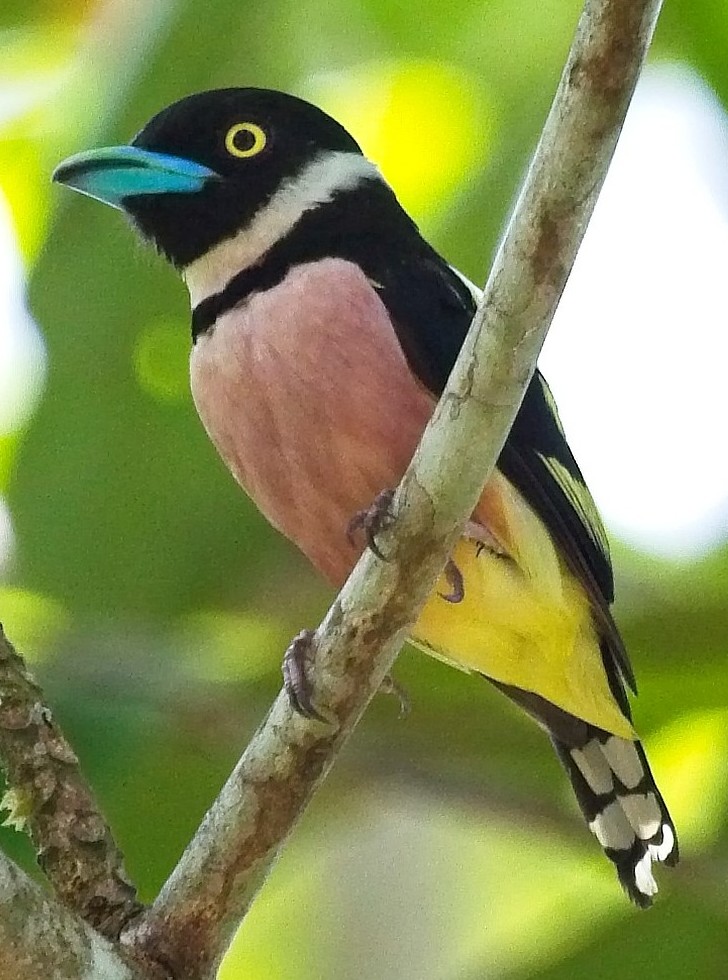
The black-and-yellow broadbill is a species of bird in the typical broadbill family Eurylaimidae. A small, distinctive species, it has a black head, breastband, and upperparts, a white neckband, yellow streaking on the back and wings, and vinous-pink underparts that turn yellow towards the belly. The beak is bright blue, with a green tip to the upper mandible and black edges. It shows some sexual dimorphism, with the black breastband being incomplete in females.
Adapted from Wikipedia, CC BY-SA 4.0.