12 Facts About the Cheetah: The World's Fastest Land Animal
Published 19 November 2026
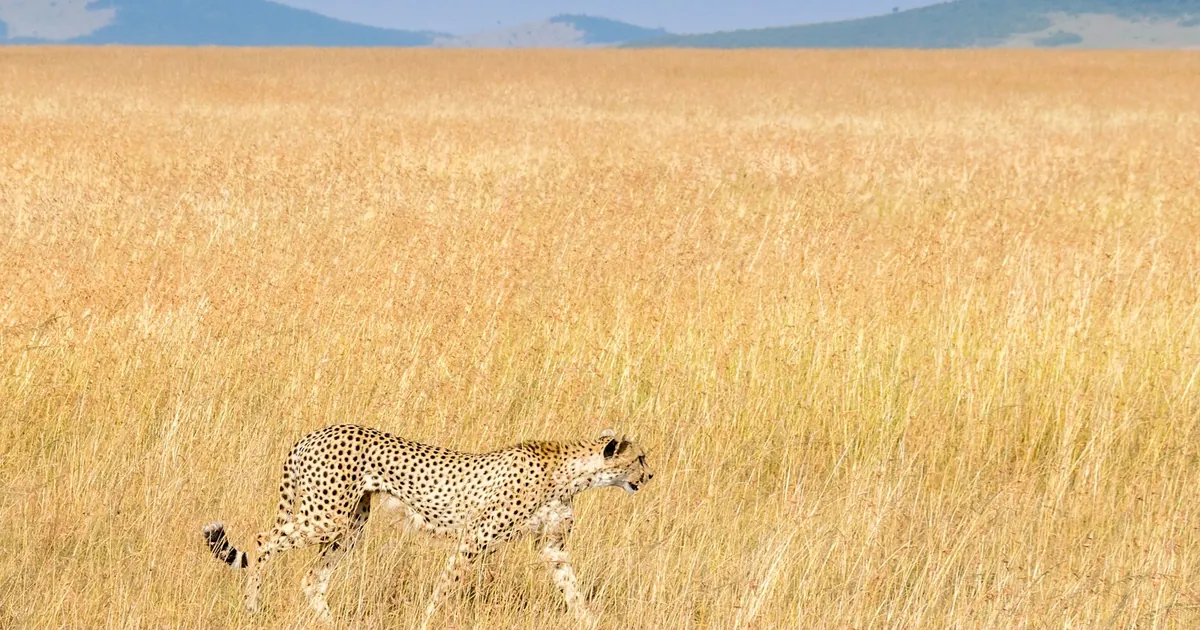
The Cheetah at a Glance
Of all Africa's iconic predators, the cheetah occupies a category entirely its own. It is not the biggest cat, not the loudest, not the strongest - yet no other land animal on Earth can match it for sheer speed. A fully grown cheetah can sprint from 0 to 112 km/h (70 mph) in roughly three seconds, a feat that puts the world's fastest sports cars to shame. But speed is only the opening chapter of a far richer story.
On a game drive across the open grasslands of Masai Mara National Reserve or the Serengeti plains, sighting a cheetah on the hunt is widely considered one of the most thrilling spectacles in wildlife. Read on for twelve facts that reveal the biology, behaviour, and conservation challenges of this extraordinary animal.
1. Built for Speed: The Anatomy Behind the Sprint
The cheetah's body is an evolutionary masterpiece shaped around one purpose: acceleration. A deep, narrow chest houses over-sized lungs and heart. Semi-retractable claws grip the ground like running spikes. A flexible, elongated spine acts as a spring, extending the stride to 6 to 7 metres at full pace. During a sprint, the cheetah spends more time airborne than on the ground.
Its running style is so extreme that it raises body temperature rapidly. A chase rarely lasts more than 30-60 seconds; if the prey escapes, the cheetah must rest for 15-30 minutes to cool down before it can eat - or attempt another hunt.
2. The Black Tear Lines Have a Function
The cheetah's most distinctive facial feature - the bold black lines running from the inner corner of each eye down to the jaw - is not merely decorative. These "tear lines" (or malar stripes) reduce sun glare in the same way a footballer uses eye black, helping the cheetah sight prey across open, sun-blasted grasslands. It is a simple anatomical trick with dramatic visual effect.
3. Unlike Other Big Cats, Cheetahs Purr
Lions roar. Leopards saw. Cheetahs purr - and the distinction matters taxonomically. Roaring cats have a partially ossified hyoid bone that allows the loud call but prevents purring. Cheetahs belong to a separate lineage (Acinonyx jubatus) with a fully flexible hyoid. They purr continuously while breathing, both in and out, and communicate with an unusually wide vocabulary of chirps, churrs, yelps, and high-pitched "stutter-barks" that can carry for more than a kilometre.
4. Cheetahs Are Active by Day
Most large African predators prefer the cover of night or dawn and dusk. The cheetah is notably diurnal, hunting primarily in the early morning and late afternoon when light is good and larger predators are resting. This schedule reduces direct competition with lions, leopards, and hyenas - all of which will steal a cheetah's kill given the chance.
The cheetah's daylight preference also makes it one of the most reliably viewable cats on safari. If you want to spot one in the wild, the Masai Mara during the peak dry season (July-October) offers some of the best odds anywhere in Africa, particularly when the wildebeest migration concentrates prey and predators alike. The great wildebeest migration guide explains exactly why this time of year transforms the Mara into Africa's most dramatic wildlife arena.
5. Males Form Coalitions; Females Are Largely Solitary
Cheetah social structure is unusual among cats. Females are almost entirely solitary except when raising cubs. Males, however, often form permanent coalitions - typically brothers from the same litter - that cooperate to defend territory and bring down larger prey. A coalition of three or four males can hold prime grassland territory for years and has even been observed taking impala that a lone cheetah could not subdue alone.
6. A Cheetah Mother Raises Cubs Alone
After a gestation of roughly 90-95 days, a female gives birth to a litter of two to six cubs. She raises them without any help from the father, moving the cubs every few days to avoid predator detection. Cubs begin accompanying their mother on hunts at about six weeks and must master hunting skills over 18 months of intensive learning. Mortality rates are high: up to 90% of cubs in some areas die before reaching adulthood, with lions and hyenas accounting for most losses.
7. Cheetah Genetics Are Remarkably Homogeneous
Sometime during the last ice age - perhaps 10,000-12,000 years ago - cheetah populations experienced a severe genetic bottleneck, reducing diversity to the point where unrelated cheetahs can exchange skin grafts without rejection. This low genetic diversity makes the species vulnerable to disease and may impair reproductive success. It is one reason why captive breeding programmes face persistent challenges.
8. The Species Has Lost Over 90% of Its Historic Range
Cheetahs once ranged from the Cape of Good Hope to the Indian subcontinent and across North Africa. Today, fewer than 7,000 individuals survive in the wild, confined largely to sub-Saharan Africa with a tiny population of Asiatic cheetahs clinging to existence in Iran. Habitat loss, human-wildlife conflict, illegal wildlife trafficking, and the shrinking of prey base have all contributed to the collapse. The cheetah is classified as Vulnerable on the IUCN Red List, though many wildlife biologists argue the situation warrants Endangered status.
For context on the broader picture of Africa's most iconic wildlife, see our guide to the Big Five safari animals - and how each is faring in the wild today.
9. Cheetahs Do Not Roar - They Chirp
The cheetah's most surprising vocalization is a chirp-bark that sounds startlingly bird-like. Mothers use it to call cubs; cubs use it to locate their mother. The call can carry across open grassland and has been mistaken by first-time safari-goers for a large bird. Hearing it unexpectedly from behind a bush is a memorable moment.
10. They Are Strictly Carnivorous and Hunt by Sight
Unlike many predators that use scent to track prey over long distances, cheetahs are primarily visual hunters. They typically scan terrain from a termite mound or fallen tree, identify a suitable target, then begin a patient stalk before the explosive sprint. Preferred prey includes Thomson's gazelle, springbok, impala, and - for coalitions - small wildebeest calves. A cheetah rarely scavenges and will almost always abandon a kill to a larger predator rather than risk injury fighting.
11. Female Cheetahs Have Large Home Ranges
Solitary females may roam home ranges of 500-1,500 square kilometres, some of the largest recorded for any cat. They do not defend these ranges territorially - females largely avoid each other. Males in coalitions hold much smaller territories of 30-80 square kilometres, which they mark aggressively with urine, faeces, and scratch marks on trees. The size of male territories is often determined by the concentration of female home ranges within them.
12. Conservation Depends on Coexistence with Farmers
With most cheetahs living outside formally protected areas - on farmland, livestock ranches, and community land - the future of the species depends on reducing conflict with farmers. Livestock predation is the primary driver of retaliatory killing. Community-based programmes that compensate farmers for livestock losses, provide livestock guardian dogs, and create buffer zones around protected areas have proven the most effective tools for stabilising cheetah populations in places like Namibia and Botswana.
To see cheetahs in the wild, East Africa is the first choice for most visitors. Kenya remains one of the most reliable destinations, with the Mara ecosystem and Laikipia Plateau both holding healthy populations. The cheetah species profile on SafariPlnr details habitat, distribution, best sighting months, and which parks offer the highest probability of an encounter.
Where to See Cheetahs in the Wild
Open savanna and semi-arid shrubland are the cheetah's preferred terrain - habitats that allow long sight lines for hunting. The best places in Africa include:
- Masai Mara, Kenya - particularly productive July-October, with multiple resident coalitions
- Serengeti, Tanzania - the plains south of Seronera hold some of Africa's densest cheetah populations
- Etosha, Namibia - excellent self-drive sightings around the waterholes
- Kgalagadi Transfrontier Park, Botswana/South Africa - semi-arid specialist, with striking red-dune backdrops
- Kruger National Park, South Africa - lower density but sightings possible in the southern and central sections
The Cheetah's Place in the Ecosystem
As a mid-tier predator, the cheetah plays a role in regulating herbivore populations - particularly gazelle and small antelope that are too fast for lions and hyenas to reliably pursue. Its preference for taking weak, injured, or young animals has a selective effect on prey herds, contributing to overall herd health. Removing cheetahs from a system tends to cause gazelle populations to spike and then crash as vegetation is overgrazed - a classic trophic cascade that illustrates why apex and near-apex predators are ecologically irreplaceable.
Understanding the cheetah means understanding the interconnectedness of the African grassland ecosystem. It is one of the most studied and best-loved species on the continent, and one of the most urgently in need of protection. If you are planning a safari and want the best chance of witnessing a hunt, talk to your guide about where resident cheetahs have been spotted recently - patient waiting at a known hunting ground is often more productive than driving miles in search of fresh tracks.