Kalahari Desert: The Complete Safari Planning Guide
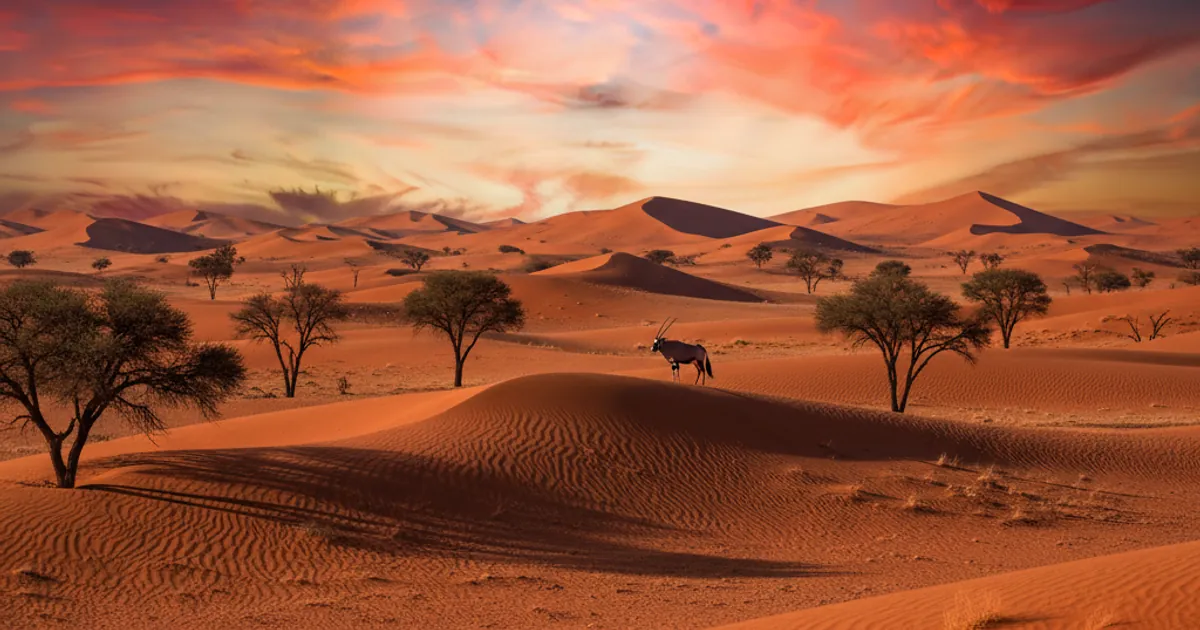
Spanning over 900,000 square kilometres across Botswana, Namibia, and South Africa, the Kalahari is not a true desert but a vast semi-arid savanna of red sand, golden grasses, and resilient wildlife. It is a place where black-maned lions stalk gemsbok across endless dunes, meerkats stand sentinel in the morning sun, and the San people have thrived for tens of thousands of years. The Kalahari offers a safari experience unlike any other - raw, remote, and profoundly beautiful.
Geographic Overview and Significance
The Kalahari stretches across most of Botswana, eastern Namibia, and the Northern Cape of South Africa. Despite its name, the Kalahari receives more rainfall than a true desert - between 110 and 500 mm annually depending on the area - which supports extensive grasslands, scattered trees, and a remarkable diversity of wildlife. The defining feature is the red Kalahari sand, ancient wind-deposited dunes that form parallel ridges running for hundreds of kilometres.
The Kalahari's most famous landscapes include the Central Kalahari Game Reserve (CKGR) in Botswana - one of the largest protected areas on Earth at 52,800 square kilometres - and the Kgalagadi Transfrontier Park, which straddles the Botswana-South Africa border. Further north, the Makgadikgadi Pans, vast seasonal salt flats, add another dimension to the Kalahari experience with their surreal, lunar landscapes.
This is ancestral land of the San (Bushmen), the oldest continuous culture on Earth. Their knowledge of the land - tracking animals, finding water in seemingly barren terrain, and reading the signs of the natural world - has been passed down for at least 20,000 years. Several lodges and community projects in both Botswana and Namibia offer guided walks with San trackers, providing a deeply meaningful cultural dimension to any Kalahari safari.
Best Time to Visit
Green Season (December to April)
Summer rains transform the Kalahari from tawny browns to vibrant greens. The pans fill with water, attracting vast herds of wildebeest, zebra, and springbok. The Makgadikgadi Pans see one of Africa's least-known but most spectacular migrations during this period. Bird life explodes with migratory species, and predator-prey interactions intensify around the temporary waterholes. Temperatures can exceed 40°C, and afternoon thunderstorms are common. This is low season for tourism, meaning lower prices and fewer visitors.
Dry Winter (May to August)
Cooler temperatures (dropping to near freezing at night) and zero rainfall make this the most comfortable time for travel. Wildlife concentrates around permanent water sources, making game viewing more predictable. The CKGR's Deception Valley and Passarge Valley are at their best. Night skies are extraordinarily clear - the Kalahari has some of the darkest skies in the world. Pack warm layers for early morning and evening game drives, as temperatures can swing by 30°C in a single day.
Hot Dry Season (September to November)
This is the Kalahari at its most extreme. Temperatures soar past 40°C and the landscape is parched and golden. Game viewing can be exceptional as animals are forced to cluster around the last remaining water. Predator activity - particularly lions, cheetahs, and leopards - peaks as prey becomes concentrated and easier to hunt. The Kgalagadi Transfrontier Park is particularly rewarding during this period, with its famous black-maned lions hunting gemsbok along the dry Auob and Nossob riverbeds.
How to Get There
Central Kalahari Game Reserve (Botswana)
Most visitors fly into Maun, the safari hub of Botswana, which receives flights from Johannesburg, Cape Town, and regional connections. From Maun, charter flights reach airstrips within the CKGR in under an hour. Self-drive is possible with a fully equipped 4x4 - the reserve's sand tracks are deep and challenging, and there are no fuel stations, shops, or facilities inside the park. This is true wilderness driving and requires experience and thorough preparation.
Kgalagadi Transfrontier Park (South Africa / Botswana)
The South African entrance at Twee Rivieren is approximately 260 km from Upington, which has an airport served by flights from Johannesburg and Cape Town. The road from Upington is tarred. The Botswana side can be accessed from Ghanzi or via the Mabuasehube entrance, but these routes require 4x4 and are only recommended for experienced overlanders.
Makgadikgadi Pans (Botswana)
Accessible from Maun (3 hours) or Nata (1 hour) by tarred road. Charter flights from Maun or Kasane serve lodges around the pans. The pans themselves require 4x4 access and a guide - it is dangerously easy to get stuck or lost on the featureless salt flats.
Key Activities and Experiences
- Game Drives in the CKGR: Open-vehicle drives through Deception Valley, Sunday Pan, and Passarge Valley in search of black-maned lions, cheetahs, brown hyenas, and the iconic gemsbok. The vast, open landscapes offer sightings with no other vehicles in sight.
- San Bushmen Walks: Guided walks with San trackers who share their ancient knowledge of medicinal plants, animal tracking, and desert survival. Available at several community-run operations and lodges in both Botswana and Namibia.
- Meerkat Habituation: At Makgadikgadi's Jack's Camp and San Camp, habituated meerkat colonies allow you to sit among them as they emerge at sunrise. The meerkats may even climb on your head for a better vantage point.
- Quad Biking on the Pans: During the dry season, the Makgadikgadi salt flats are hard and flat enough for quad bike excursions - riding across a vast white expanse that stretches to every horizon.
- Stargazing: With virtually zero light pollution, the Kalahari offers some of the best stargazing in Africa. Several lodges provide telescopes and guided astronomy sessions. The Milky Way is visible in staggering detail.
- Sleep-outs: Some lodges offer the option to sleep on a raised platform under the stars, with nothing between you and the vast Kalahari sky. It is an unforgettable experience.
Wildlife You Will Encounter
The Kalahari supports a surprising diversity of wildlife adapted to its harsh conditions. The undisputed star is the black-maned Kalahari lion - a population of lions with distinctively dark manes that have become the symbol of the region. These lions are lean, powerful, and adapted to hunting across open terrain with minimal cover.
Gemsbok (South African oryx) are the Kalahari's most abundant large antelope, perfectly adapted to survive without surface water by extracting moisture from the plants they eat. Springbok are everywhere, and their pronking displays - leaping high into the air with arched backs - are a classic Kalahari sight.
The Kalahari is one of the best places in Africa to spot cheetahs - the flat, open terrain is ideal for their high-speed hunts. Brown hyenas, Africa's rarest large predator, are found throughout the Kalahari and are more commonly seen here than anywhere else on the continent. African wild dogs pass through the CKGR and northern Kalahari on their enormous home ranges.
Smaller predators include bat-eared foxes, black-backed jackals, Cape foxes, and the honey badger - one of Africa's most fearless and entertaining animals. Meerkats are abundant and several habituated colonies offer intimate viewing. Elephants are present in the northern Kalahari near the Okavango, though absent from the drier southern regions.
Bird life is excellent, particularly during the wet season when migrants swell the species count. Raptors are a highlight - martial eagles, secretary birds, pale chanting goshawks, and lappet-faced vultures are all regularly sighted. The crimson-breasted shrike, with its vivid red breast against the red sand, is the Kalahari's signature bird.
Accommodation Options
The Kalahari's remoteness means accommodation tends towards the extremes. In the Kgalagadi Transfrontier Park, SANParks operates rest camps at Twee Rivieren, Nossob, and Mata-Mata with self-catering chalets and campsites - good value and well-maintained. The park also has several exclusive wilderness camps (Kieliekrankie, Gharagab, Bitterpan, Urikaruus) with stunning locations and complete solitude.
In the CKGR and Makgadikgadi, luxury lodges such as Kalahari Plains Camp, Jack's Camp, San Camp, and Camp Kalahari offer high-end tented safari experiences with expert guiding. These are expensive but provide access to areas and experiences you simply cannot replicate independently.
For self-drivers, bush camping in the CKGR is possible at designated campsites - these are unfenced, unmarked, and utterly wild. You must be fully self-sufficient with water, food, fuel, and firewood. This is for experienced overlanders only, but the reward is unparalleled solitude in one of Africa's last great wilderness areas.
Photography Tips
- Golden hour is everything. The Kalahari's red sand glows intensely at sunrise and sunset, creating warm, dramatic light that flatters every subject. Plan your most important shooting around these hours.
- Dust is a constant challenge. The fine red Kalahari sand gets into everything. Use a dust-proof camera bag, change lenses inside a plastic bag, and carry a rocket blower to clean your sensor regularly. A UV filter on every lens is essential insurance.
- The landscape demands wide angles. The immense scale of the Kalahari - endless dunes, vast pans, enormous skies - is best captured with a wide-angle lens (16-35mm). Include foreground interest like animal tracks, dried grass, or a lone tree to give scale.
- For predators, bring long glass. A 100-400mm or 200-600mm zoom is ideal. Kalahari animals can be approachable, especially in the Kgalagadi where they are habituated to vehicles, but you still need reach for hunting sequences.
- Night photography is exceptional. A fast wide-angle lens (f/2.8 or wider) and a sturdy tripod will capture the Milky Way arching over the desert. Many lodges position sleep-out platforms specifically for this purpose.
- Meerkat photography requires a low angle. Get down to their level for intimate portraits. A 70-200mm lens at ground level produces professional-quality meerkat images. Pre-set your exposure as they move quickly.
Practical Tips
- Temperature extremes: The Kalahari experiences some of the widest daily temperature ranges on Earth. In winter, mornings can be below freezing while afternoons reach 25°C. In summer, expect 40°C+ during the day. Dress in layers and carry warm gear even in summer for cool evenings.
- Water: There is no reliable surface water in most of the Kalahari. If self-driving, carry a minimum of 20 litres per person plus vehicle water. Dehydration is a serious risk, especially in the hot months.
- Vehicle preparation: For self-drive in the CKGR or Makgadikgadi, you need a fully equipped 4x4 with high clearance, two spare tyres, a tyre repair kit, recovery gear (sand tracks, tow rope, shovel), a satellite phone or GPS messenger, and all fuel for the entire trip. There are no fuel stations inside the reserves.
- Malaria: The northern Kalahari (CKGR, Makgadikgadi) is a seasonal malaria area with risk increasing in the wet season. The southern Kalahari (Kgalagadi) is generally malaria-free. Consult your travel doctor and see our Botswana safety guide for current advice.
- Navigation: GPS is essential in the CKGR, where tracks are poorly marked and look identical. Download offline maps and carry paper maps as backup. Getting lost in the Kalahari without adequate water and supplies is life-threatening.
- Booking: CKGR campsites and Kgalagadi wilderness camps book out months in advance, especially for the South African school holidays (December-January, March-April, June-July). Book as early as possible.
Nearby Parks and Side Trips
- Okavango Delta (Botswana): Just north of the Kalahari, the Okavango is the world's largest inland delta - a complete contrast to the desert, with water-based safaris, mokoro canoe trips, and incredible wildlife density.
- Makgadikgadi Pans (Botswana): If visiting the CKGR, the pans are a natural extension. The zebra migration, meerkat encounters, and surreal salt flat landscapes make this a unique addition.
- Namib Desert (Namibia): For a desert-to-desert contrast, combine the Kalahari with the ancient Namib and its towering Sossusvlei dunes. The two deserts could not be more different in character.
- Augrabies Falls (South Africa): If entering the Kgalagadi from Upington, the Augrabies Falls National Park is a worthwhile detour - the Orange River plunges 56 metres into a narrow granite gorge.
Conservation and Environmental Notes
The Kalahari faces environmental pressures from cattle ranching, which has encroached on wildlife habitat and disrupted ancient migration routes through the construction of veterinary cordon fences. The CKGR was the subject of a landmark legal battle when the government of Botswana attempted to relocate San communities from the reserve - the San won the right to return in a 2006 High Court ruling, though tensions remain.
Climate change is intensifying the Kalahari's aridity. Research suggests the desert is expanding southward, and temperature extremes are becoming more pronounced. Conservation programs focused on predator-livestock coexistence, community-based natural resource management, and transfrontier wildlife corridors are critical to the Kalahari's long-term ecological health.
When visiting, support lodges and operators that employ local communities, contribute to conservation levies, and use sustainable practices. The Kalahari's wildlife survives not in spite of humans but alongside them - and the San people's relationship with this land holds lessons for conservation worldwide.
Key Takeaways
- 1The Kalahari is not a true desert — it receives enough rain to support grasslands, trees, and remarkable wildlife including black-maned lions and cheetahs
- 2The Kgalagadi Transfrontier Park offers excellent self-drive safari with affordable SANParks accommodation, while the CKGR requires full 4x4 overlanding preparation
- 3Dry winter months (May-August) offer the most comfortable travel and concentrated game viewing, while the green season (Dec-Apr) brings dramatic landscapes and migrations
- 4San Bushmen cultural walks are a highlight unique to the Kalahari — book with community-run operations to ensure benefits reach local people
- 5Temperature swings of 30°C+ in a single day are normal — always pack layers regardless of when you visit
- 6The Kalahari has some of the darkest skies in Africa, making stargazing and astrophotography exceptional year-round
- 7Combine the Kalahari with the Okavango Delta for a desert-to-delta contrast that showcases Botswana's extraordinary ecological diversity
Frequently Asked Questions
Is the Kalahari a real desert?
Technically, no. The Kalahari is classified as a semi-arid savanna because it receives more rainfall (110-500mm annually) than a true desert. It supports grasslands, scattered trees, and diverse wildlife. However, it shares many characteristics with deserts - deep sand, extreme temperatures, and limited surface water. The southern Kalahari, including the Kgalagadi area, is the driest and most desert-like.
Do you need a 4x4 for the Kalahari?
It depends on where you go. The Kgalagadi Transfrontier Park's main roads are accessible to 2WD vehicles with high clearance, though 4x4 is recommended. The Central Kalahari Game Reserve absolutely requires a fully equipped 4x4 with recovery gear, extra fuel, and water. The Makgadikgadi Pans should only be driven on with a guide and 4x4. Lodge-based safaris handle all transport for you.
Where can I see meerkats in the Kalahari?
The most famous meerkat experiences are at Jack's Camp, San Camp, and Camp Kalahari on the edge of the Makgadikgadi Pans in Botswana. These lodges have habituated meerkat colonies that allow incredibly close encounters. Meerkats are also found throughout the Kgalagadi Transfrontier Park, though they are wilder and less approachable there.
What is the best time of year to visit the Kalahari?
May to August offers cool, dry weather with concentrated wildlife around water sources. September to November is hotter but delivers exceptional predator sightings. December to April (green season) transforms the landscape, brings the zebra migration to Makgadikgadi, and offers lower prices. Each season has compelling reasons to visit.
Is the Kalahari safe for families with children?
The Kgalagadi Transfrontier Park is excellent for families - self-drive safaris let you go at your own pace, rest camps have family chalets, and the open landscape makes spotting animals easy even for young children. Lodge-based Kalahari safaris often have age restrictions (typically 6-12 years minimum) due to the remoteness. The CKGR is not recommended for families unless highly experienced in overlanding.