The Shoebill: 12 Extraordinary Facts About Africa's Most Bizarre Bird
Published 12 February 2026
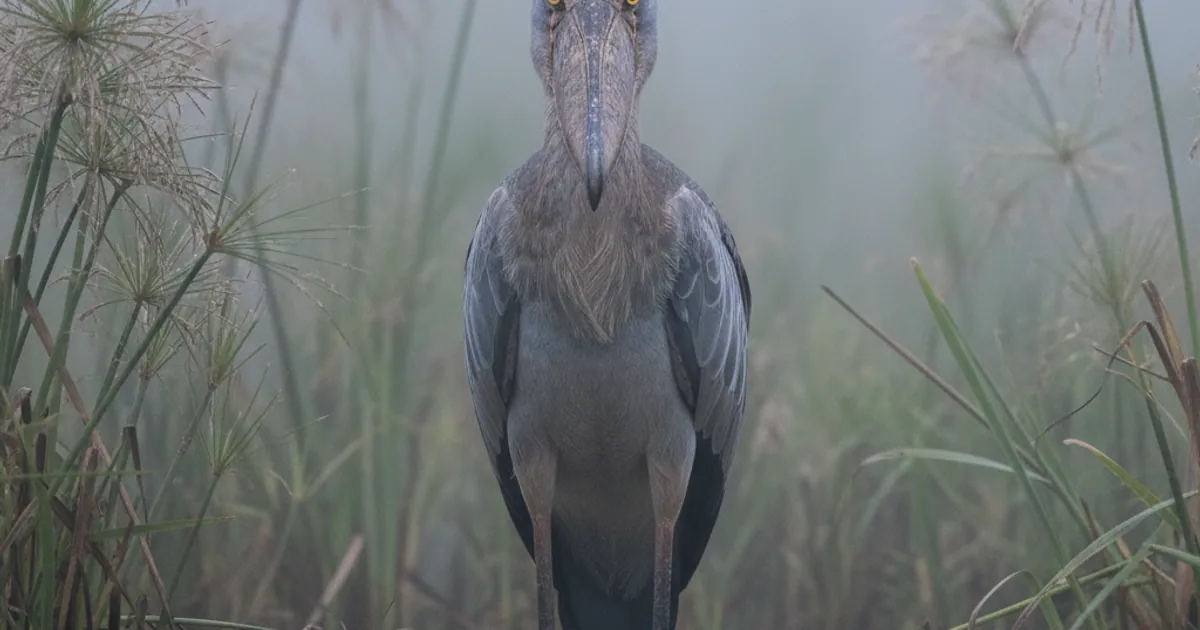
Africa's Most Sought-After Bird
The shoebill (Balaeniceps rex) is a prehistoric-looking wading bird that stands over 1.2 metres tall and sports a massive shoe-shaped bill that can measure 24 centimetres long and 20 centimetres wide. Found only in the papyrus swamps and marshlands of central-east Africa, this extraordinary bird has become one of the most coveted sightings for birdwatchers visiting the continent.
With an estimated population of just 3,300 to 5,300 individuals, the shoebill is classified as Endangered by the IUCN. Uganda is the most reliable country for sightings, particularly at Mabamba Bay on the shores of Lake Victoria.
1. Its Bill Is a Lethal Weapon
The shoebill's enormous bill is not just for show - it is a precision hunting tool. The upper mandible ends in a sharp, nail-like hook that can slice through the toughest fish scales and even decapitate prey. The bill's edges are razor-sharp, designed to grip slippery lungfish, the shoebill's primary food source. When the bird strikes, it does so with the full weight of its head and neck, collapsing forward onto its prey in a dramatic lunge.
2. It Can Stand Motionless for Hours
The shoebill's hunting strategy is one of extraordinary patience. It stands completely still in shallow water - sometimes for over an hour - watching for movement beneath the surface. When a lungfish rises to breathe, the shoebill strikes with explosive speed, plunging its entire head and bill into the water. This ambush technique requires minimal energy, a crucial adaptation in the nutrient-poor swamp environments where shoebills live.
3. It's a Relative of Pelicans, Not Storks
Despite its stork-like appearance, genetic studies have revealed that the shoebill is more closely related to pelicans and herons than to storks. It is the sole living member of the family Balaenicipitidae, making it a truly unique lineage. The species has no close living relatives, which adds to its mystique and conservation importance.
4. They Practice Siblicide
Shoebills typically lay two to three eggs, but in most cases only one chick survives to fledging. The larger, first-hatched chick aggressively dominates its siblings, stealing food and attacking them. The parents do not intervene. This brutal strategy - known as siblicide - ensures that at least one strong chick survives rather than spreading limited food resources too thinly. The "insurance" eggs serve as backup in case the first egg fails to hatch.
5. They Communicate by Bill-Clattering
Adult shoebills are largely silent birds, but they produce a remarkable machine-gun-like clattering sound by rapidly snapping their upper and lower mandibles together. This bill-clattering is used during courtship, nest defence, and greeting ceremonies between mated pairs. The sound carries across the swamp and is often the first indication that a shoebill is nearby.
6. Their Wingspan Reaches 2.5 Metres
Despite their heavy build, shoebills are strong fliers with wingspans reaching 2.3 to 2.6 metres. In flight, they retract their necks like herons rather than extending them like storks - another clue to their true evolutionary relationships. They soar on thermals when travelling between feeding areas but generally prefer to stay close to their home swamp.
7. Lungfish Are Their Primary Prey
Shoebills have evolved alongside African lungfish (Protopterus species), which form the bulk of their diet. Lungfish are air-breathers that must surface periodically, creating the predictable movement patterns that shoebills exploit. Shoebills also eat catfish, tilapia, frogs, water snakes, and even young Nile crocodiles.
8. They're Surprisingly Tolerant of Humans
Unlike many large birds, shoebills show remarkably little fear of quiet, respectful human observers. Experienced birding guides in Uganda can often approach within 5 to 10 metres of a feeding shoebill. This tolerance has made them a viable ecotourism species, generating revenue that supports their conservation. At Mabamba Bay, local fishermen serve as guides, creating direct economic incentives to protect shoebill habitat.
9. They're Solitary by Nature
Shoebills are among the most solitary of all African birds. Even mated pairs typically forage at opposite ends of their territory, which can span several square kilometres of swamp. They come together only for breeding and nest duties. This extreme territoriality means that prime shoebill habitat supports relatively few individuals, making large, intact wetlands essential for the species' survival.
10. Their Population Is Declining
The shoebill is classified as Endangered, with the global population estimated at 3,300 to 5,300 mature individuals. The primary threats are habitat loss (drainage of wetlands for agriculture), disturbance from cattle grazing, nest predation, and illegal capture for the exotic pet trade. A single shoebill can fetch up to $10,000 on the black market, creating devastating incentives for poaching.
11. Uganda Is the Best Place to See Them
While shoebills occur in several countries - including Zambia, Rwanda, Tanzania, and South Sudan - Uganda offers the most reliable sightings. The top locations are:
- Mabamba Bay Wetland - the most accessible site, just 50 km from Kampala. Local canoe guides find shoebills with remarkable consistency.
- Murchison Falls National Park - shoebills inhabit the delta where the Victoria Nile enters Lake Albert.
- Ziwa Rhino Sanctuary - shoebills are frequently spotted along the swamp edges.
12. They Look Like Living Dinosaurs
There is something undeniably prehistoric about the shoebill. Its cold, penetrating stare, massive bill, and statue-like hunting posture give it an otherworldly quality that has earned it the nickname "the most terrifying bird in Africa." In reality, shoebills are gentle giants - their intimidating appearance belies a calm temperament. Meeting one in the wild is an experience that birders describe as life-changing.
Planning a shoebill expedition? Check our Uganda country guide and explore the Wildlife Directory for more African species.