Safari Photography: The Best Camera & Lens Setup for Every Budget
Published 26 June 2026
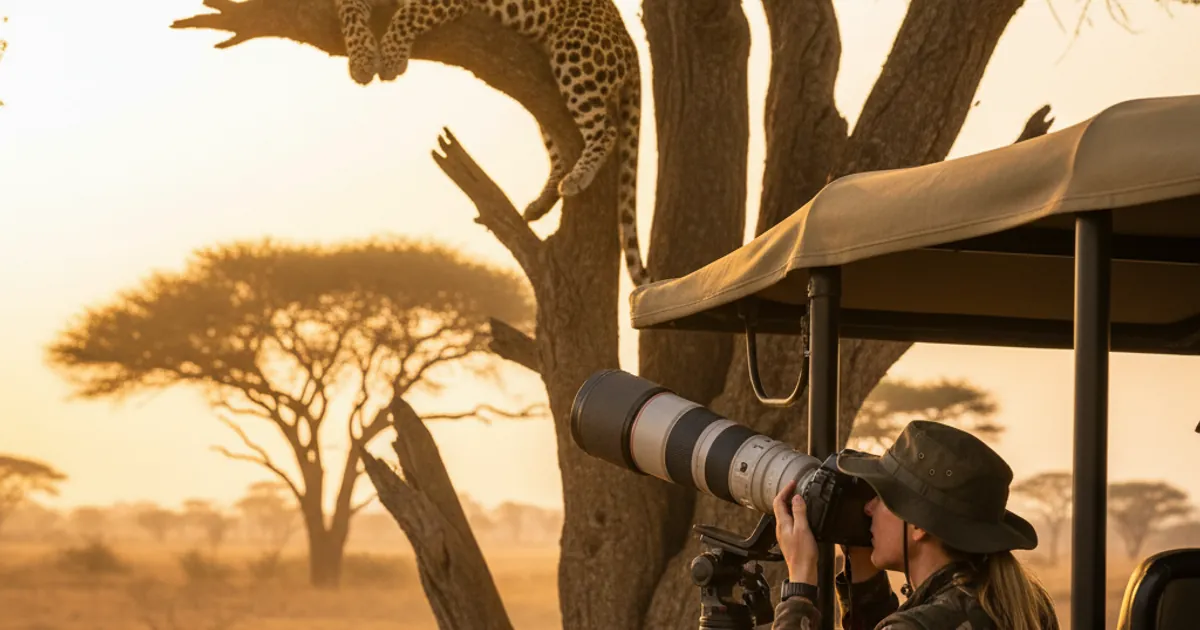
Capturing the Wild: Safari Photography for Every Level
Great safari photography isn't about having the most expensive camera - it's about knowing your gear, understanding light, and being ready when the action happens. Whether you're shooting with a smartphone or a professional mirrorless rig, this guide covers the gear, settings, and techniques that will help you bring home images that do justice to Africa's extraordinary wildlife.
Tier 1: Smartphone and Compact Camera ($0–500)
Modern smartphones take surprisingly good safari photos, especially in good light. If you're a first-time safari-goer and photography isn't your primary focus, your phone is absolutely fine. Here's how to maximise it:
- Use the native camera app - third-party apps add complexity without real benefit for wildlife
- Digital zoom degrades quality fast - get as close as your guide will allow before zooming
- Burst mode is your friend - hold the shutter button for rapid-fire shots of moving animals
- Clean your lens - dust and fingerprints on a phone lens ruin sharpness
- Consider a clip-on telephoto lens - options like the Moment 58mm add genuine reach without bulk
If you want a step up from a phone without going full mirrorless, a premium compact camera with a built-in zoom lens is excellent. Models like the Sony RX10 IV (24–600mm equivalent) or Canon PowerShot SX70 HS give you massive zoom range in a lightweight package for $500–1,800.
Tier 2: Enthusiast Mirrorless ($1,000–3,000)
This is the sweet spot for serious safari photography without going professional. A crop-sensor or full-frame mirrorless camera paired with a versatile zoom lens will capture stunning images in almost any condition.
Recommended Camera Bodies
- Sony a6700 (crop sensor, ~$1,400) - Excellent autofocus, lightweight, great for pairing with Sony telephoto lenses
- Nikon Z50 II (crop sensor, ~$1,000) - Solid all-rounder, good value
- Canon R7 (crop sensor, ~$1,500) - Outstanding autofocus with animal eye detection, 15fps burst
- Sony a7C II (full frame, ~$2,200) - Compact full-frame, superb image quality
Recommended Lenses
- Sony 70–350mm f/4.5–6.3 G (~$900) - Sharp, lightweight, ideal for crop-sensor Sony bodies. 525mm equivalent reach.
- Canon RF 100–400mm f/5.6–8 (~$650) - Surprisingly good for the price, very portable
- Tamron 50–400mm f/4.5–6.3 (~$1,300) - Incredible range in one lens, good for safari where you can't change lenses quickly
- Sigma 100–400mm f/5–6.3 DG DN (~$950) - Available for Sony and L-mount, sharp and affordable
At this tier, your total investment (body + lens) runs $1,500–3,500. This setup will handle 90% of safari situations beautifully.
Tier 3: Professional Setup ($3,000–10,000+)
If wildlife photography is a passion and you want the best possible results, a full-frame mirrorless body with a fast super-telephoto lens is the gold standard.
Camera Bodies
- Sony a7R V (~$3,900) - 61MP, extraordinary detail for cropping, excellent AF
- Nikon Z8 (~$4,000) - Pro-level features, 20fps raw burst, superb wildlife AF
- Canon R5 Mark II (~$4,300) - 45MP, 30fps electronic shutter, class-leading eye AF
Lenses
- Sony 200–600mm f/5.6–6.3 G (~$2,000) - The most popular safari lens in the world. Sharp across the range, relatively affordable for what it delivers, internal zoom (length doesn't change). Heavy at 2.1kg but manageable with a beanbag.
- Nikon Z 180–600mm f/5.6–6.3 (~$1,700) - Nikon's answer to the Sony 200–600, excellent value and sharpness
- Canon RF 100–500mm f/4.5–7.1L (~$2,700) - Compact for its reach, L-series quality, weather-sealed
- Sony 600mm f/4 GM (~$13,000) - The ultimate wildlife lens. Extraordinarily sharp and fast, but weighs 3kg and costs as much as the safari itself.
Camera Settings for Safari Wildlife
Getting the right settings dialled in before the action starts is critical. Animals don't wait while you fumble with menus. These settings work across all cameras:
Shutter Speed
- Stationary animals: 1/500s minimum
- Walking animals: 1/1000s
- Running, flying, action: 1/2000s–1/4000s
- Birds in flight: 1/3200s minimum
When in doubt, go faster. A sharp, slightly noisy image is always better than a smooth, blurry one.
ISO
Modern cameras handle high ISO remarkably well. Don't be afraid to push to ISO 3200–6400 in early morning or late afternoon light. ISO 800–1600 is fine in good daylight. Auto ISO with a maximum cap (ISO 6400 or 12800) lets you focus on composition while the camera manages exposure.
Autofocus
- Use continuous autofocus (AF-C / Servo) for all wildlife - animals are almost never truly still
- Enable animal eye detection if your camera has it (most modern mirrorless cameras do). This is transformational for wildlife photography.
- Use a wide area AF zone for action and unpredictable movement, single point for stationary subjects in cluttered backgrounds
Burst Mode
Set your camera to its highest continuous shooting speed. Modern cameras can shoot 10–30 frames per second. For a leopard hunt, a river crossing, or birds in flight, burst mode is the difference between getting the shot and missing it. Just be prepared to delete hundreds of near-identical frames each evening.
Composition Tips for Safari
- Eye level is everything: The most powerful wildlife images are shot at the animal's eye level. Safari vehicles naturally place you at a good height for large mammals, but for smaller animals, ask your guide if you can lower yourself.
- Rule of thirds: Place the animal's eye on a power point (where the grid lines intersect). Leave space in front of a moving or looking animal - let them "walk into" the frame.
- Use the environment: Don't always zoom in tight. Pull back to show the animal in its landscape - a lone elephant against a vast savanna, a leopard in an ancient tree. These images tell a story.
- Patience over spray-and-pray: Sometimes the best shot comes five minutes after you find the animal. Wait for a yawn, a turn of the head, eye contact, or an interaction with another animal.
- Silhouettes: Position animals against sunrise or sunset for dramatic silhouettes. This works beautifully for giraffes, elephants, and acacia trees.
Light: The Make-or-Break Factor
Light quality matters far more than equipment cost. Safari photography thrives in two windows:
- Golden hour (first hour after sunrise, last hour before sunset): Warm, directional light that makes every image glow. This is when you get the most beautiful images. Conveniently, this coincides with peak animal activity.
- Overcast days: Even, soft light that's actually excellent for portraits and close-ups - no harsh shadows on faces.
Harsh midday light (10am–3pm) is challenging. During this time, focus on animals in shade, silhouettes against bright sky, or abstract details (textures, patterns, eyes). Or simply put the camera down and enjoy the moment.
Backlit Shots: The Secret Weapon
Many photographers avoid shooting into the light, but backlighting creates some of safari's most stunning images. The rim light around a lion's mane, dust kicked up by buffalo glowing gold in the sunrise, the translucent ears of an elephant - these are moments that only work with backlight. Underexpose slightly and let the highlights glow.
Practical Gear Tips
- Beanbag: More useful than any tripod on safari. Drape it over the vehicle door and rest your lens on it. Stable, adjustable, packable. Buy one filled with polystyrene beads, or bring an empty bag and fill it with rice or beans on arrival.
- Memory cards: Bring at least 2–3 high-speed cards (128GB or larger). Format in-camera, not on a computer. Consider bringing a portable SSD for evening backups.
- Batteries: Bring 3+ fully charged batteries. Cold mornings drain batteries faster. Charge every night.
- Sensor cleaning: Bring a rocket blower (not compressed air). Dust will get on your sensor - it's inevitable. A blower solves most issues without risk.
- Dust covers: A simple plastic rain sleeve protects your camera on dusty roads. Zip-lock bags work in a pinch.
Basic Editing
Even minimal editing dramatically improves safari photos:
- Crop tighter: Most safari shots benefit from a tighter crop to emphasise the subject
- Boost shadows and warmth: African light photographs slightly cooler than it looks in person - add a touch of warmth
- Sharpen: Apply modest sharpening, especially for images you'll share on social media (compression softens everything)
- Remove distractions: Clone out a fence post, twig, or vehicle mirror that crept into the edge of frame
Free tools like Snapseed (mobile) and Lightroom Mobile (free tier) handle all of the above. Shoot in RAW if your camera supports it - this gives you far more editing flexibility than JPEG.
Next steps: Browse our equipment guide for specific product links and prices. Check the safari packing list for how to pack your camera gear within bush flight weight limits. Explore Africa's wildlife to identify species you'll want to photograph, and find the best parks for your photography goals. Study individual species like lions, leopards, and elephants to understand their behaviour and anticipate great shots.