10 Facts About the Nile Monitor: Africa's Largest Lizard
Published 4 May 2026
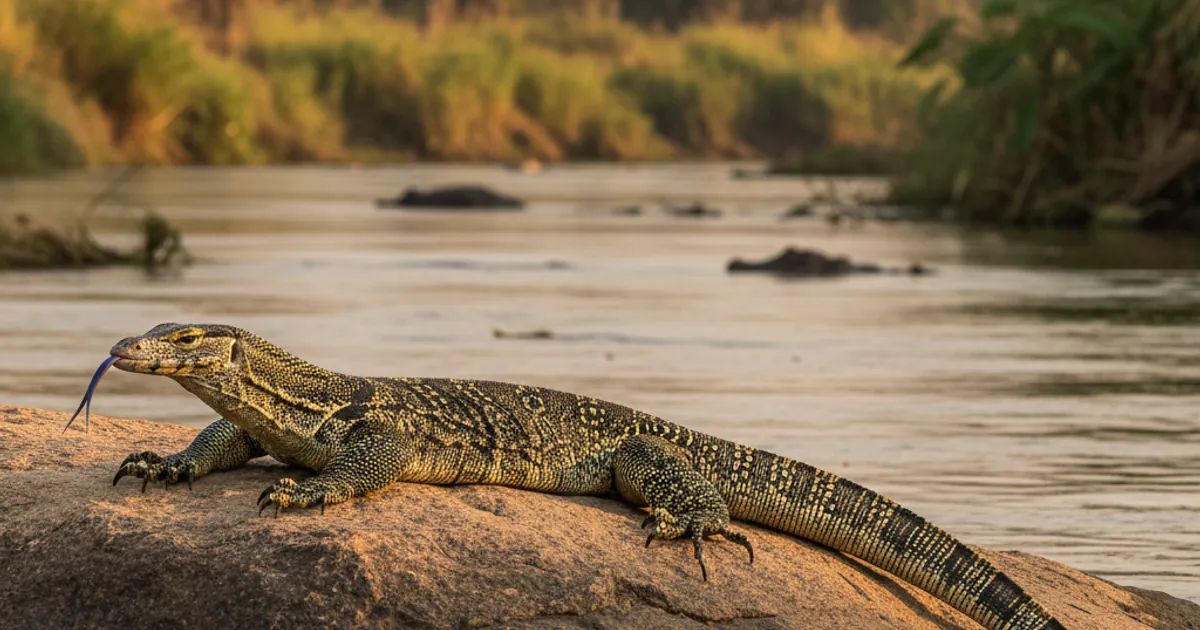
Africa's Formidable Lizard
The Nile monitor (Varanus niloticus) is the largest lizard in Africa, capable of reaching 2.4 metres in total length and weighing up to 20 kilograms. Found near rivers, lakes, and wetlands across sub-Saharan Africa, these powerful reptiles are a common but often overlooked safari sighting. Their intelligence, boldness, and predatory versatility make them one of the continent's most fascinating creatures.
1. They're Closely Related to Komodo Dragons
Nile monitors belong to the family Varanidae - the same family as the Komodo dragon, the world's largest living lizard. Monitor lizards are among the most intelligent reptiles, possessing higher metabolic rates and more complex behaviours than most other lizard families. The Nile monitor is the second-most widespread monitor species after the Asian water monitor.
2. They Raid Crocodile Nests
One of the Nile monitor's most remarkable behaviours is its habit of raiding Nile crocodile nests. Working in pairs, one monitor distracts the guarding female crocodile while the other digs up and eats the eggs. This bold strategy is remarkably risky - a female crocodile defending her nest can easily kill a monitor - but the nutritional reward of protein-rich crocodile eggs makes it worthwhile.
3. They're Semi-Aquatic Hunters
Nile monitors are equally at home on land, in trees, and in water. They are strong swimmers, using their laterally compressed tail as a rudder and propulsion device. Underwater, they hunt fish, crabs, mussels, and frogs. On land, they pursue rodents, birds, insects, and carrion. In trees, they climb with surprising agility to raid bird nests and eat eggs. This versatility makes them one of Africa's most successful predators.
4. Their Bite Can Cause Serious Infection
While Nile monitors are not venomous, their mouths harbour significant bacterial populations that can cause serious infections in bite wounds. A defensive monitor will bite, scratch, and whip with its powerful tail. Their claws are long and sharp, adapted for climbing trees and excavating burrows. Anyone who has handled a wild Nile monitor will attest to the ferocity of their defensive response.
5. They're Surprisingly Fast
On land, Nile monitors can sprint at speeds exceeding 20 km/h - fast enough to outrun most humans over short distances. They typically flee to the nearest water or tree when threatened, and their explosive acceleration from a basking position often startles safari-goers who thought they were approaching a log.
6. They Have Forked Tongues
Like snakes, Nile monitors use a forked tongue to "taste" the air and track prey. The tongue collects scent particles and transfers them to the Jacobson's organ in the roof of the mouth, providing detailed chemical information about the environment. Monitors constantly flick their tongues while foraging, building a chemical map of their surroundings.
7. They Dig Deep Burrows
Nile monitors excavate burrows in riverbanks and termite mounds for shelter and nesting. Females lay 20 to 60 eggs inside active termite mounds - the termites then seal the entrance, providing a temperature-controlled incubation chamber. The mother returns months later to dig out the hatchlings. This remarkable nesting strategy exploits the termites' construction abilities for the monitor's benefit.
8. They're Indicators of Ecosystem Health
As top predators in aquatic and riparian ecosystems, Nile monitors are indicators of environmental health. Their presence suggests adequate prey populations, clean water, and intact habitats. Declining monitor populations can signal broader ecosystem degradation, making them an important species for conservation monitoring.
9. They Can Hold Their Breath for Over an Hour
Nile monitors are exceptional divers, capable of remaining submerged for over an hour. They use this ability to escape predators, hunt underwater prey, and traverse submerged passages. When swimming at the surface, they adopt a distinctive S-shaped posture with the head raised above water and the tail undulating for propulsion.
10. They're Found Across Most of Africa
Nile monitors have one of the broadest distributions of any African reptile, found from Egypt to South Africa and from Senegal to Somalia. They are present in virtually any habitat with permanent water, from coastal mangroves to inland swamps, rivers, and dams. They are also found on several African islands and have established invasive populations in Florida, USA.
Where to See Nile Monitors
Nile monitors are common along waterways across Africa. Look for them basking on rocks and riverbanks:
- Kruger National Park, South Africa - abundant along the major rivers
- Murchison Falls, Uganda - seen on boat safaris along the Nile
- Chobe River, Botswana - common on boat trips
- Abuko Nature Reserve, Gambia - easily spotted in this small reserve
Discover more reptile species in our Wildlife Directory.