The Complete Guide to Safari in Namibia
Desert-adapted wildlife, Etosha, Sossusvlei, and Africa's best self-drive country
Why Choose Namibia for Your Safari?
Namibia is unlike any other safari destination in Africa. Where Kenya and Tanzania deliver grassland savannahs teeming with wildebeest, Namibia offers something far more surreal: desert-adapted elephants wandering through dry riverbeds, ancient welwitschia plants surviving in landscapes that haven't seen rain in years, and towering red dunes that rank among the tallest on Earth.
Namibia is also the continent's premier self-drive destination. With one of the lowest population densities in the world (just 3 people per square kilometre), a well-maintained network of tarred and gravel roads, and a stable, safe political environment, Namibia rewards independent travellers with a freedom that's hard to find elsewhere in Africa. You can drive for hours without seeing another vehicle, camp under some of the darkest skies on the planet, and discover landscapes that look like they belong on another world.
Despite its arid reputation, Namibia supports remarkable biodiversity. The country is home to the world's largest free-roaming population of black rhinos, desert-adapted elephants and lions that have learned to survive in some of the harshest conditions on Earth, and the extraordinary Skeleton Coast - where the cold Atlantic meets the searing Namib Desert, creating fog banks that sustain a unique web of life.
Top Attractions & Parks
Etosha National Park
Etosha is Namibia's premier wildlife park, centred on a vast salt pan visible from space. During the dry season (May–October), the park's artificial and natural waterholes become magnets for wildlife - elephants, lions, leopards, black and white rhinos, giraffes, zebras, and dozens of antelope species all converge to drink. The beauty of Etosha is its simplicity: you park at a waterhole, switch off the engine, and wait. Animals come to you. The park has three main rest camps (Okaukuejo, Halali, Namutoni) with accommodation, restaurants, fuel, and floodlit waterholes for night viewing.
Sossusvlei & the Namib Sand Sea
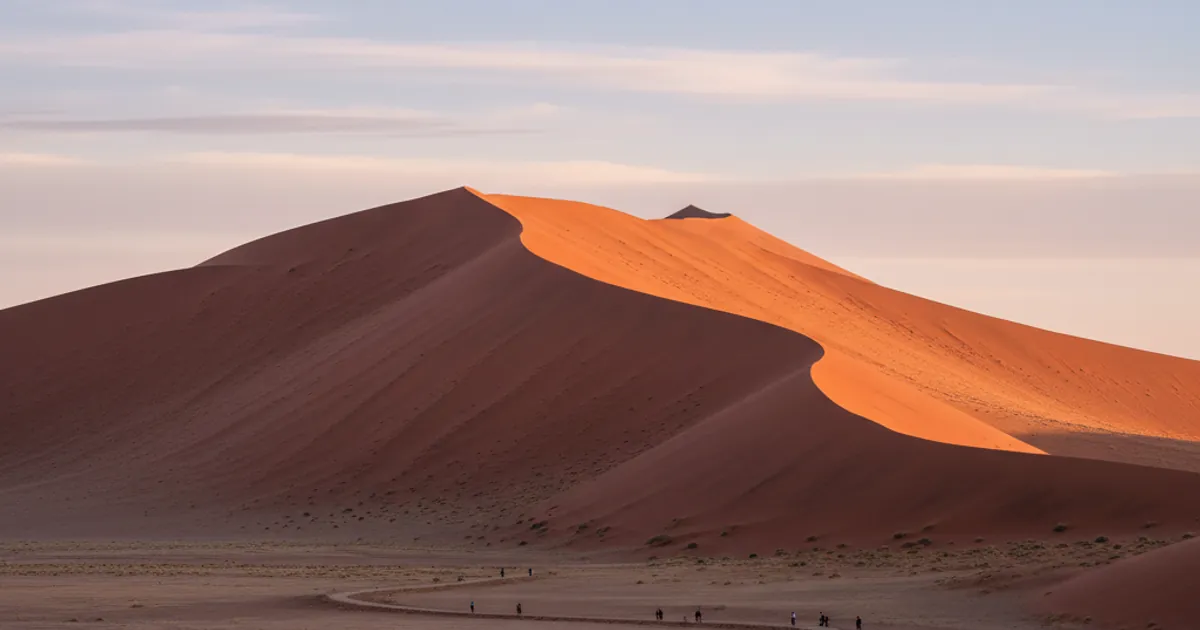
The towering red dunes of Sossusvlei are Namibia's most photographed landscape and a UNESCO World Heritage Site. Dune 45 and Big Daddy (over 300 metres tall) glow orange and crimson at dawn. Deadvlei - a white clay pan dotted with 900-year-old dead camel thorn trees - is one of the most otherworldly scenes in Africa. Sesriem Canyon, carved by the Tsauchab River, adds geological drama. Stay at lodges or camps within the Namib-Naukluft Park for pre-dawn gate access.
Skeleton Coast
This remote, fog-shrouded coastline is littered with shipwrecks, whale bones, and Cape fur seal colonies. The northern Skeleton Coast is accessible only by fly-in safari, offering one of Africa's most exclusive and atmospheric wilderness experiences. The southern section (around Cape Cross and Terrace Bay) is reachable by road and offers seal colonies, fishing, and eerie coastal drives. Desert-adapted lions and brown hyenas patrol the shore.
Damaraland
The rocky, semi-arid landscapes of Damaraland are home to Namibia's famous desert-adapted elephants - herds that have learned to survive on minimal water by travelling vast distances along dry riverbeds. Tracking these elephants on foot or by vehicle is a profound experience. Damaraland also features Twyfelfontein, a UNESCO site with over 2,500 ancient rock engravings, and the Brandberg massif, Namibia's highest mountain.
Caprivi Strip (Zambezi Region)
Namibia's northeastern panhandle is a world apart from the rest of the country - lush, green, and watered by the Zambezi, Kwando, and Chobe rivers. The Caprivi offers boat safaris, excellent birding (over 430 species), and wildlife including elephants, hippos, buffalo, and wild dogs. It also provides a natural corridor linking Namibia with Botswana's Chobe and Zimbabwe's Victoria Falls, making it ideal for cross-border itineraries.
Waterberg Plateau Park
This flat-topped sandstone plateau rises 200 metres above the surrounding bush and serves as a sanctuary for rare and endangered species, including sable antelope, roan antelope, and tsessebe. Guided walks on the plateau top offer a unique perspective. Waterberg is a convenient stop between Windhoek and Etosha.
Desert-Adapted Wildlife
Namibia's most remarkable wildlife stories are about adaptation. In the country's northwest - particularly the Kunene Region and Damaraland - several species have evolved behaviours that allow them to thrive in extreme aridity:
- Desert-Adapted Elephants: These elephants (genetically the same as savannah elephants) have learned to dig for water in dry riverbeds, travel up to 70 km in a day between water sources, and survive on far less water than their counterparts in lusher environments.
- Desert-Adapted Lions: The lions of the Skeleton Coast and Kunene Region hunt gemsbok, springbok, and even seals along the coast. Their territories are vastly larger than those of savannah lions, and their survival in such harsh conditions has been documented in Dr Philip Stander's long-running research project.
- Black Rhinos: Namibia protects the largest free-roaming population of black rhinos in Africa. Many are tracked by community-based conservancies in the northwest, and specialist rhino-tracking safaris offer the chance to approach these critically endangered animals on foot.
Self-Drive Guide
Namibia is purpose-built for self-drive exploration. Key considerations:
- Road Types: Namibia has roughly 5,500 km of tarred roads (B-roads) and over 37,000 km of gravel roads (C- and D-roads). Gravel roads are generally well-maintained but require slower speeds (80 km/h max) and awareness of loose gravel on corners.
- 2WD vs 4WD: A standard 2WD sedan handles all major routes including Etosha, Sossusvlei (to the 2WD parking area), Waterberg, and the main B-roads. A 4x4 is essential for Damaraland's back roads, the final stretch to Deadvlei, the Skeleton Coast north of Terrace Bay, and the Caprivi's sandy tracks.
- Fuel Stops: Plan fuel carefully. Distances between towns can exceed 300 km. Fill up at every opportunity in remote areas. Most stations accept credit cards, but carry cash as a backup.
- Driving Times: Namibia is vast. Windhoek to Sossusvlei is 5 hours; Sossusvlei to Swakopmund is 5 hours; Swakopmund to Etosha is 5 hours. Don't try to cover too much - build in rest days.
- Safety: Namibia is one of Africa's safest countries. Avoid driving at night (animals on roads, poor visibility on gravel). Carry a spare tyre and basic tools. Cell coverage is patchy outside towns.
Tip: Book your rental car and NWR (Namibia Wildlife Resorts) accommodation well in advance for the peak season (July–October). Popular camps like Okaukuejo and Sesriem fill up months ahead.
Best Time to Visit Namibia
- June – October (Dry/Winter): The best period for Etosha game viewing. Cool, clear days (20–25°C) and cold nights (can drop below freezing). Animals concentrate at waterholes. Peak tourist season - book well ahead.
- November – December: The build-up to the rains. Hot (35°C+) but dramatic skies and the first green shoots. Fewer tourists, good rates. Etosha's game viewing is still strong early in this period.
- January – April (Green Season): Summer rains transform the landscape. Etosha's pan may partially fill with water, attracting flamingos. Wildlife disperses away from waterholes, making game viewing harder but photography dramatic. Newborn animals appear. This is peak time for Sossusvlei - the dunes are equally spectacular year-round.
See our Namibia seasonal guide for detailed monthly advice.
What Does a Namibia Safari Cost?
Namibia offers excellent value, especially for self-drive travellers:
- Self-Drive Budget ($80–$150/person/day): Rental car ($40–$80/day for a 2WD sedan), NWR rest camp accommodation ($30–$60/night per room), self-catering from supermarkets. Etosha park fees are just $8/person/day - a fraction of East African rates.
- Self-Drive Mid-Range ($150–$350/person/day): 4x4 rental, mix of NWR camps and private lodges, some restaurant meals. This level accesses more remote areas like Damaraland.
- Guided/Luxury ($400–$1,500+/person/day): Fly-in lodges in the Skeleton Coast and remote concessions, expert guides, all-inclusive. Properties like Serra Cafema, Hoanib Skeleton Coast Camp, and the Ongava lodges near Etosha offer world-class experiences.
Sample Routes
14-Day Classic Namibia Loop
Windhoek → Sossusvlei (3 nights, dunes at dawn, Deadvlei, Sesriem Canyon) → Swakopmund (2 nights, coastal town, adventure activities, Walvis Bay flamingos) → Damaraland (2 nights, desert elephants, Twyfelfontein) → Etosha (3 nights, western and eastern sectors, waterholes) → Waterberg or Okonjima (1 night, AfriCat Foundation, cheetahs and leopards) → Windhoek. This is Namibia's greatest-hits route and works perfectly as a self-drive itinerary.
7-Day Highlights
Windhoek → Sossusvlei (2 nights) → Swakopmund (1 night) → Etosha (3 nights) → Windhoek. A condensed version covering the must-sees. Tight on driving days but feasible with early starts. Consider internal flights to save time.
Stargazing: NamibRand Dark Sky Reserve
Namibia is home to Africa's first International Dark Sky Reserve - the NamibRand Nature Reserve, adjacent to Sossusvlei. With virtually zero light pollution, the Milky Way here is staggeringly bright, and the southern constellations are visible in their full glory. Several lodges in NamibRand offer dedicated stargazing programmes with telescopes and expert guides. For photographers, Namibia's night skies over the desert are a powerful reason to visit in their own right.
For the complete list of Namibia's parks and wildlife areas, visit the Namibia destination page. Gear up for your self-drive adventure with our safari equipment guide, or browse the best safari parks in Africa.